

Printing Knowledge Library
What Is Die Cutting in Printing?
Die cutting in printing is a finishing process that uses a custom die, made of sharp steel rules bent into a shape and set in a wood base, to press through printed sheets and cut them into shapes a straight paper cutter cannot make. It is how boxes, pocket folders, hang tags, puzzle pieces and shaped cards get their outlines, and the same die can score fold lines and add perforations in the same pass.

By Kraig Downham, Marketing Director, with Printing Partners since 2005. Updated November 17, 2026.
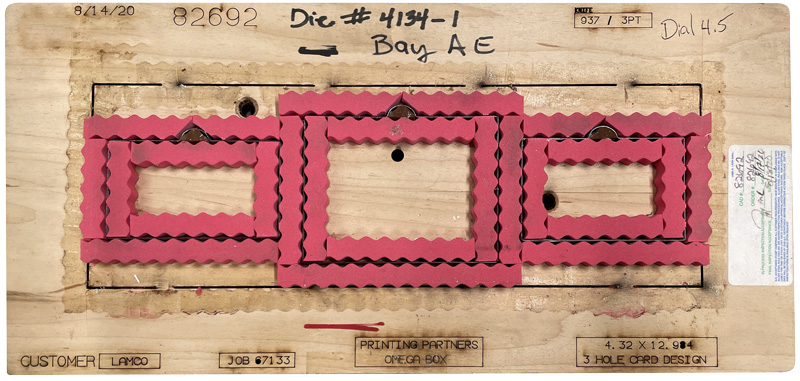
A guillotine cutter can only make straight cuts through a stack of paper. Any curve, notch, window, slot or interior cut needs a die. At Printing Partners we die cut in house in Indianapolis on our own Heidelberg S28, and the photo below shows one of our cutting dies.
How Die Cutting Works, Step by Step
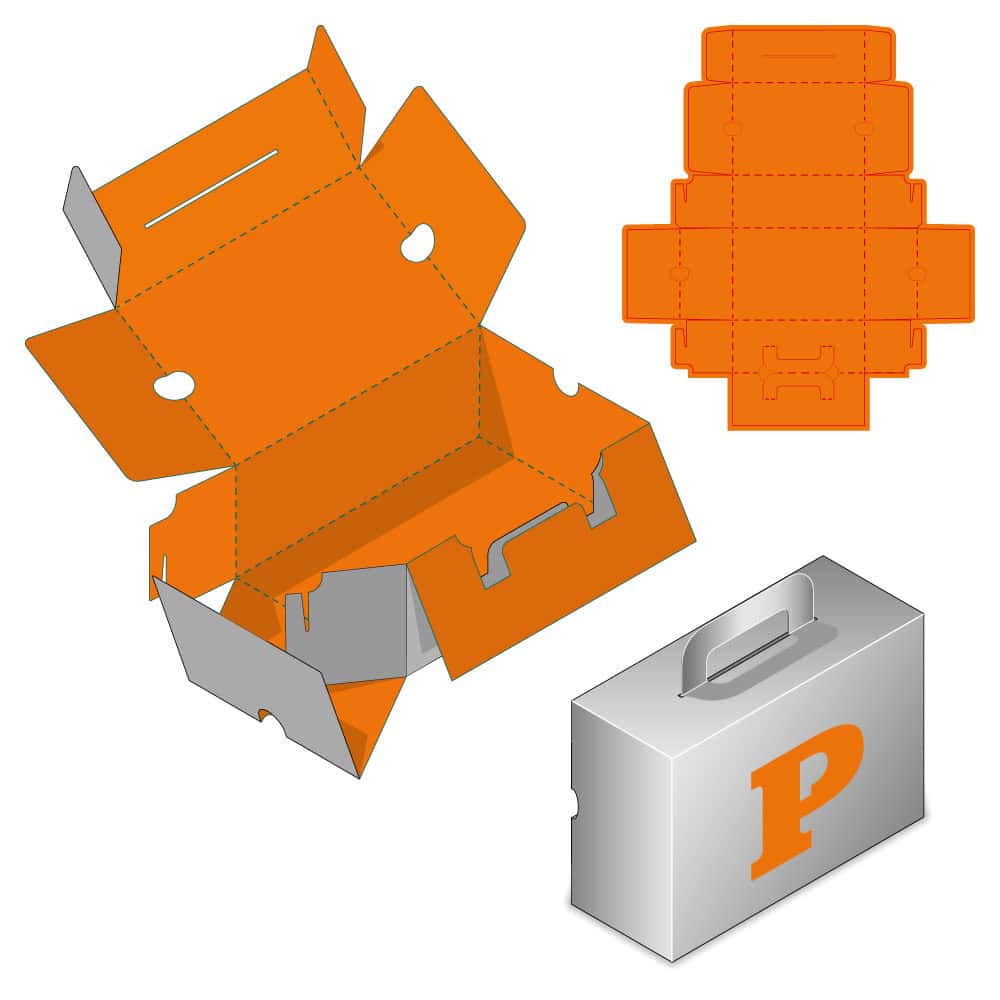
- Build the dieline. A dieline is the vector outline that tells the die maker where to cut, score and perforate. It sits on its own layer above the artwork, in named spot colors. By convention a solid line is a cut, a dashed line is a score or fold, and a dash-dot line is a perforation. For new packaging projects, we build the dieline from your product dimensions.
- Make the die. Steel rule is bent to match the dieline and set into a wood base, with cushions alongside the knives to hold the sheet. Cutting rules are sharp, and scoring rules are blunt so they crease the board instead of cutting it. Die quality decides how cleanly pieces separate, which is why ours are built by toolmakers who understand the tolerances.
- Print the sheet with bleed. Artwork extends 0.125 inch past every cut line, so a small shift in the cut never leaves a white edge. See our guide to printer bleed for why.
- Finish before cutting. Lamination, spot UV and foil stamping go on while the sheet is still flat. Die cutting comes after them so every effect lines up with the final shape.
- Cut, score and perforate in one impression. The die is locked into a die cutting press and pressure drives the knives through the sheet. Our Heidelberg S28 die cutter takes sheets up to 21 x 28 inches with a die area up to 20.375 x 26 inches, depending on the die design.
- Strip and inspect. The waste around each piece is removed. On packaging jobs, finished cartons are checked against the approved proof for color, registration and die cut accuracy before they are counted, packed and shipped.
Types of Die Cuts and Dies
Not every die cuts all the way through the sheet. These are the operations a die can perform, and many jobs combine several of them.
Through cut
The standard die cut. The knife cuts completely through the sheet to create a custom shape, such as a box flat, a hang tag or a shaped card.
Kiss cut
The knife cuts through the top layer of a sticker or label but not the backing liner, so the pieces peel off a sheet that stays intact.
Score or crease
A blunt rule presses a fold line into the sheet so thick stock and carton board fold cleanly without cracking.
Perforation
A rule with small gaps cuts a tear line instead of a full cut, for reply cards, coupons and tickets.
Emboss and deboss
A matched die raises or recesses the paper surface without cutting it. See our embossing page.
Foil stamping and combination
A heated die transfers foil to the sheet. A combination die embosses and foils in one pass for a sculpted effect.
Embossing, debossing and foil stamping run on our Heidelberg GTP platen, which handles sheets and dies up to 13 x 18 inches. Cutting and scoring dies run on the S28. You can see every press and finishing machine on our equipment list.
Die Cutting vs a Straight Trim
| Question | Guillotine trim | Die cutting |
|---|---|---|
| Shapes it can make | Straight edges and rectangles only | Any outline, including curves, notches, windows, slots and interior cuts |
| Extra operations | None | Scores, perforations and kiss cuts in the same pass |
| Tooling | No tooling. Our Polar and Perfecta cutters trim to size. | A custom die, which is a one time cost that can be reused on reprints |
| Typical products | Flyers, postcards, letterhead, standard business cards | Boxes, puzzles, pocket folders, hang tags, door hangers, shaped cards |
| File setup | Trim marks and 0.125 inch bleed | A vector dieline on its own layer, plus 0.125 inch bleed past every cut |
What We Die Cut
Die cutting shows up across our work, from retail packaging to promotional pieces.
- Folding cartons and boxes. We print and die cut folding cartons on SBS board from 10pt to 28pt, including custom tuck boxes. Visit our custom packaging printing page for structures, board and finishing options.
- Jigsaw puzzles. Steel rule dies cut each printed and mounted sheet into interlocking pieces. We maintain dies for standard piece counts from 100 through 2,000 and build custom dies for unique shapes. See custom puzzle manufacturing.
- Pocket folders. The pockets, slits for business cards and glue flaps of a pocket folder are all cut and scored by one die.
- Hang tags and door hangers. Shaped outlines, string holes and the hanger opening of hang tags and door hangers are die cut.
Packaging is where die cutting matters most, and it is where a physical sample pays for itself. You can see one of our packaging projects in the award winning Smoking Goose box.
Design Tips for Die Cut Pieces
- Keep text and logos inside a safe margin, away from cut and fold lines.
- Add small radii to inside corners. Sharp inside corners can nick or tear.
- Allow 1/32 to 1/16 inch of mechanical tolerance on complex finishing, and avoid designs that depend on hairline alignment between print, foil and cut.
- Score heavier stocks before folding. A coated sheet can crack along an unscored fold.
- Ask for a full size mockup or physical sample before approving a structure, so you can check fit, fold order and closure.
Our step by step guide to creating die cut files covers layers, spot color naming, line weights and export settings in detail. For folded pieces, the folding calculator helps you confirm panel sizes.
Frequently Asked Questions
What is the difference between die cutting and kiss cutting?
Die cutting usually means a through cut, where the knife cuts completely through the material to create a separate shape. Kiss cutting cuts only through the top layer of a sticker or label and leaves the backing liner intact, so the pieces can be peeled off a sheet.
What is a dieline?
A dieline is the vector outline in a print file that shows where the die will cut, score and perforate. It sits on its own layer in named spot colors and is set to overprint so it does not knock out the artwork. Solid lines usually mean cut, dashed lines mean score or fold, and dash-dot lines mean perforate.
How much does die cutting cost?
The main added cost is the die itself, which is a one time tooling charge based on its size and complexity. After that, the die can be reused on reprints, and the cost per piece drops as quantity rises. We quote every die cut job individually based on the die, the stock and the quantity.
Do I need to create my own dieline?
No. For new packaging projects, we create the dieline from your product dimensions as part of the job. If you already have a dieline, send it with your artwork and our prepress team will review it before anything is made.
Can a die be reused for a reprint?
Yes. We keep dies and dielines on file, so reorders of the same shape move faster and do not need new tooling. Our puzzle work depends on it, because keeping dies on file is what makes fast reprints possible.
What materials can be die cut?
Most paper and board can be die cut, from cover stock to the SBS carton board, 10pt to 28pt, that we use for folding cartons. Puzzles are cut from printed sheets that have been laminated and mounted to chipboard. Our Heidelberg S28 die cutter takes sheets up to 21 x 28 inches.
Is die cutting the same as embossing?
No. Both use a die, but a cutting die slices through the sheet while an embossing die presses a raised or recessed design into it without cutting. Foil stamping uses a heated die to transfer foil, and a combination die can foil and emboss in one pass.
Have a Shape in Mind?
Send us your product dimensions or your artwork and we will recommend a structure, a stock and the right die. Printing Partners has been family owned by the O'Brien family since 1989, with prepress, printing and die cutting under one roof at 929 W 16th Street in Indianapolis.