Saddle stitch is the fast, low-cost binding behind most programs, newsletters, and short catalogs: sheets folded together and stapled through the spine, no glue and no rigid case. Printing Partners staples every job in the same Indianapolis building as the press, from a single proof copy to a full production run.
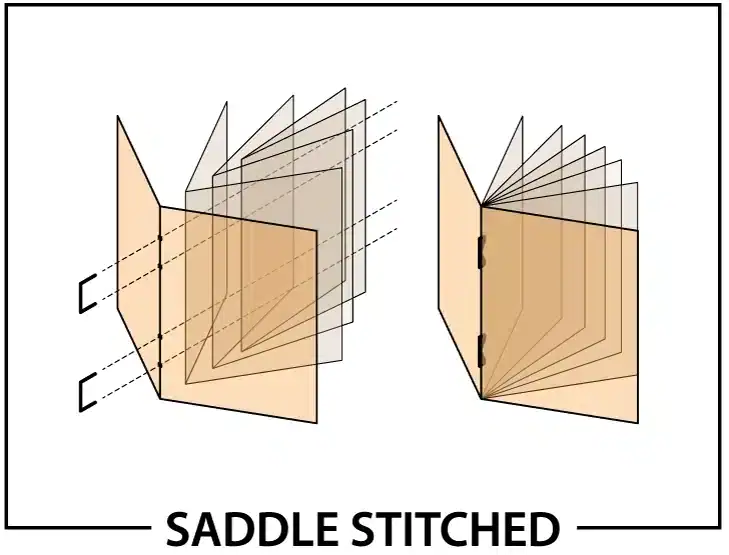
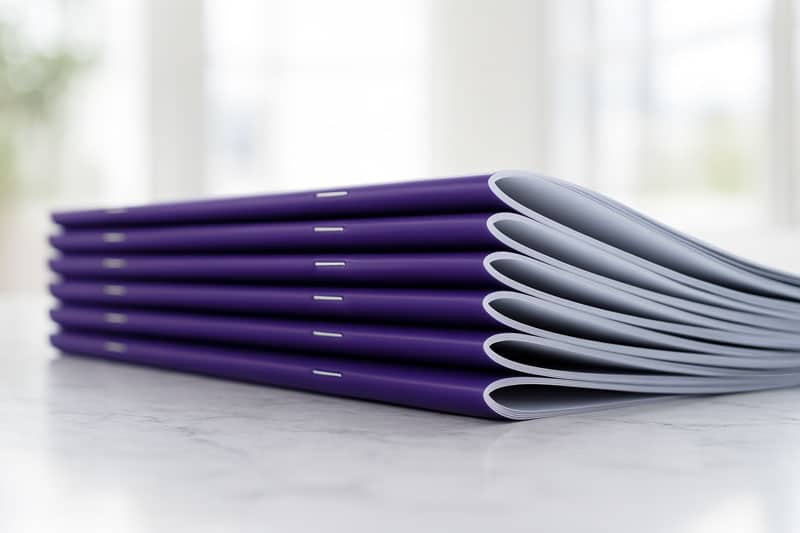
Saddle stitch binding, also called stapled binding, folds a set of printed sheets into a single nested unit called a signature and fastens them through the spine fold with two wire staples. There is no glue and no rigid spine involved, which is why it is the fastest and least expensive binding method a commercial printer runs. A booklet bound this way opens nearly flat and is read cover to cover in one pass, exactly the behavior a program, newsletter, or short catalog needs.
The mechanics are simple by design. Sheets print flat, fold in half, and nest inside one another rather than stacking and trimming at the spine, which is why the total page count has to land on a multiple of four to fold correctly. Two staples go through the fold from the outside in, catching every nested sheet in a single pass. Because nothing is glued, the booklet lies close to flat right away, no spine to break in.
The real limit is thickness, not page design. Past roughly 64 pages, the innermost sheets start to push out beyond the outer edge as the fold thickens, an effect printers call creep, and the trim begins eating into the inside margin. That is the point where perfect binding or coil binding takes over.
Saddle stitch is the right call anytime a piece is thin, produced on short notice, or handed out rather than shelved. It is the default booklet binding method for booklet printing under 64 pages, and the low per-unit cost makes it the standard choice for anything printed in the hundreds or thousands.
Weddings, recitals, conferences, and church bulletins. Printed close to the date and handed out once.
Product lines under 64 pages that need a low per-unit cost more than a printable spine.
Recurring mailers and internal newsletters where speed and budget matter more than long-term durability.
The traditional comic book and zine format. Nests naturally and opens flat for panel-to-panel reading.
Onboarding guides and reference booklets replaced on a schedule, where a lasting binding is not worth the cost.
Line cards and spec packets that need more room than one sheet but do not carry a spine title.
A saddle stitched booklet is built from folded signatures, and the page count has to land on a multiple of four so every sheet nests and folds cleanly. Printing Partners runs saddle stitch from 8 pages up to a practical ceiling of about 64 pages on standard text stock. Heavier cover or text stock lowers that ceiling, since a thicker fold reaches the creep limit sooner.
Saddle stitch booklets come in two cover styles. A self-cover booklet uses the same paper stock for the cover and the interior pages, printed as part of the same signature, which is the cheapest option and common for programs and newsletters. A plus-cover booklet adds a separate, usually heavier cover stock wrapped around the interior pages and stapled through with them. Plus-cover costs a little more but reads as a more finished, durable piece, and it is the better choice for catalogs and anything handled repeatedly.
Low. Staples hold up fine for a piece read a handful of times. For something that needs to survive daily handling, perfect binding or coil binding will outlast it.
Lowest of the six binding methods we run, because there is no glue, no case, and press time is fast.
No minimum quantity. We saddle stitch a single proof copy or a full production run in the same shop.
Standard turnaround is 3 to 5 business days from an approved proof. Rush turnaround is available depending on the press schedule, ask when you request your quote.
Saddle stitch and perfect binding are the two workhorse bindings for booklets and books, and the choice usually comes down to page count. Under about 64 pages, saddle stitch is cheaper and faster. Once a piece is thick enough to need a spine you can read on a shelf, typically 48 pages and up, perfect binding takes over.
| Attribute | Saddle stitch | Perfect binding |
|---|---|---|
| Page range | 8 to 64 | 48 to 800 |
| Spine | Folded, no printable spine | Square, glued, printable |
| Lies flat | Nearly | No |
| Relative cost | Lowest | Low at volume |
| Best for | Programs, newsletters, short catalogs | Paperbacks, manuals, catalogs sold on a shelf |
If your page count is climbing past 64, or landing in the upper range where saddle stitch starts to creep, perfect binding is the better fit, and it gives you a spine to print a title on. See the perfect binding page for full specs, or start with the binding guide to compare every method side by side.
Saddle stitch binding at Printing Partners happens in the same Indianapolis building as the printing, not at a separate bindery across town. That keeps a short-run program or a next-day catalog moving from press to finished piece without a truck in between.
Folding, stapling, and trimming happen on-site at 929 W 16th Street. Nothing ships out to a subcontractor and back.
Color is calibrated and checked run to run, so a reprint of the same booklet matches the first one.
Our quality process is documented and audited, not dependent on one operator having a good day.
Decades running saddle stitch alongside perfect binding, coil, Wire-O, case binding, and Smyth sewn, in one building.
Have a book instead of a booklet in mind? See book printing services for longer-run and case-bound work.
Saddle stitch binding folds printed sheets into a nested signature and staples them through the spine fold with two wire staples. There is no glue and no rigid spine involved, which makes it the fastest and least expensive way to bind a booklet. It is also called stapled binding for the same reason.
Saddle stitch works well from 8 pages up to a practical ceiling of about 64 pages on standard text stock. The page count has to be a multiple of four so the signature folds and nests correctly. Heavier paper lowers the maximum because the folded sheets get bulkier and start to creep, an effect where inner pages push out past the trim edge. Past that range, perfect binding or coil binding is the better fit.
Saddle stitch staples folded sheets through the spine fold and works best under about 64 pages. Perfect binding grinds the spine edge flat and glues it into a wraparound cover, which supports 48 to 800 pages and gives you a printable spine. Saddle stitch is cheaper and faster for a thin piece; perfect binding is the better choice once a book is thick enough to read on a shelf.
Yes. Saddle stitch and stapled binding describe the same method: printed sheets are folded together and stitched through the center fold with two wire staples. The name comes from the way the folded booklet straddles a saddle-shaped support during production.
For most booklets under 64 pages, saddle stitch is the best binding. It costs the least, runs the fastest, and the finished piece lies nearly flat for easy reading. Once a booklet grows past that range, or you want a printed spine, perfect binding is the better option.
A self-cover booklet uses the same paper stock for the cover and interior pages, printed as one signature, which keeps cost down. A plus-cover booklet adds a separate, usually heavier cover stock wrapped around the interior pages and stapled through with them, giving the piece a more finished, durable feel for a modest cost increase.
No. Printing Partners saddle stitches everything from a single proof copy to a full production run in the same Indianapolis facility. Short runs are common for programs and internal booklets that need to print close to the event date.
Yes. Saddle stitch binding is performed in house at our facility at 929 W 16th Street, Indianapolis, Indiana, in the same building as the presses. That keeps a booklet moving from print to finished piece without shipping to an outside bindery, which matters most on jobs printed close to a deadline.
Send the page count, the quantity, the trim size, and the cover stock you have in mind. We will confirm saddle stitch is the right fit, quote it, and print and bind it in house. There is no minimum, so it can be one proof copy or a full production run.
Printing Partners
929 W 16th Street, Indianapolis, IN 46202
317-635-2282
Use the estimate form to send your specs. Include page count, quantity, trim size, and cover style, and we will confirm the fit and quote it.
Start My EstimateLast updated: August 12, 2026. Binding performed in house in Indianapolis. Page counts are practical working ranges and vary with stock and trim size.
© Printing Partners. All rights reserved. | Privacy Policy | Publishing Principles | Ownership & Funding Info | Feedback Policy | Corrections Policy | Ethics Policy | Diversity Policy | Diversity Staffing Report | Accessibility Statement | LLMS