



A Family Owned Business For Over 36 Years

Crafting print with precision since 1989—trusted by businesses, fueled by innovation, and driven by purpose.

Contact Us
  • 929 W 16th Street,
    Indianapolis, IN

  • 317 635 2282

.
Magazine printers in Indianapolis since 1989

Custom magazine printing and mailing services

Saddle stitched, perfect bound, and Wire-O magazines printed, bound, addressed, poly bagged, and delivered to the post office in one job. Trim sizes from digest to 9 by 12 inches, page counts from 8 to 96, and a mailing department in the same building as the presses.

  • G7 Master certified color
  • ISO 9001:2015 quality
  • FSC certified paper available
A stack of Indy In Focus magazines printed and bound by Printing Partners in Indianapolis
Printed and bound in house, Indianapolis

The magazine printer publishers keep coming back to

When your issue is ready to print, you need one company that can print it, bind it, and mail it on schedule, every issue. Printing Partners runs every stage under one roof in Indianapolis, with G7 certified color that holds from your first issue to your fiftieth and a mailing department a few steps from the presses. Send us the files and the list, and the finished magazine reaches your subscribers on time.

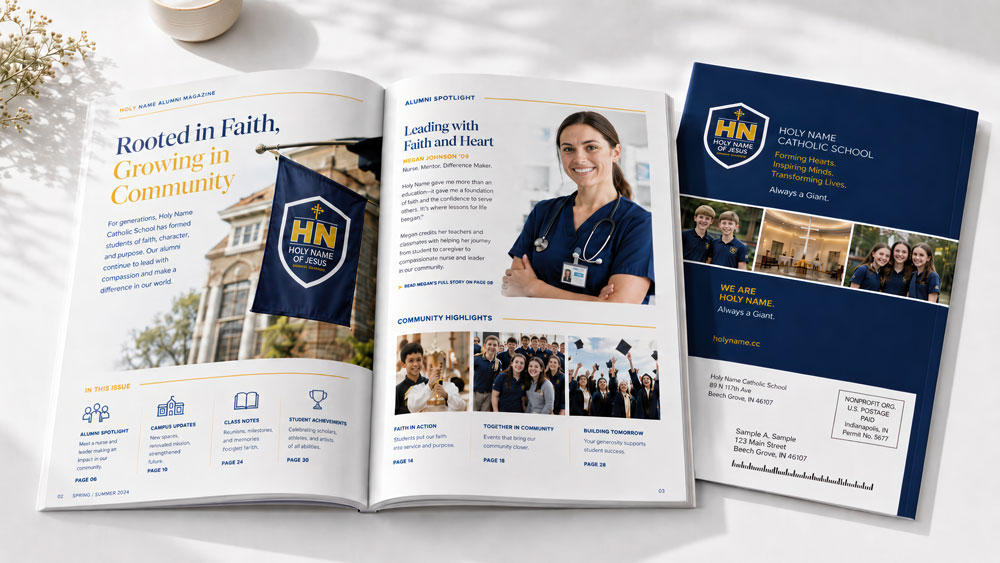
An open Holy Name alumni magazine printed by Printing Partners, shown with its addressed bulk mail panel
  • Print and mail in one placeAddressing, sorting, poly bagging, and USPS delivery are done here, not trucked to a third party mail house between stages, which is where recurring titles usually lose days.
  • G7 Master certified colorCovers and photography match from issue to issue, verified against a certified standard rather than matched by eye.
  • Built for recurring titlesYour specification, stocks, and color targets stay on record, so the next issue is a repeat order rather than a fresh setup.
  • ISO 9001:2015 qualityDocumented quality management with prepress checking every file before it reaches press. See our ISO certification.
  • FSC certified stockChain of custody certified and recycled papers when the publication carries a sustainability claim. See FSC certified printing.
  • Family owned since 1989Joel and Mary O'Brien and their children Liam, Logan, and Bailey are still directly involved in the work at 929 W 16th Street in Indianapolis.

Magazine binding compared

Saddle stitch is the cheapest and fastest binding and lies nearly flat, which makes it the default for lower page count magazines. Perfect binding gives you a printable square spine for thicker issues that readers shelve. Wire-O lies completely flat and suits reference style publications read on a desk.

Binding methods for magazines at Printing Partners, Indianapolis. Page count must be a multiple of four. Published page ranges for every binding we run, including saddle stitch and perfect binding, are in the binding guide; we confirm the right one for your trim size and stock when we quote.
Binding Page count it suits Printable spine Lies flat Relative cost Typical magazine
Saddle stitch Lower page counts. Folded sheets are stapled through the spine fold, so capacity is limited by how much the fold will hold No Nearly Lowest Association newsletters, member magazines, programs, quarterly titles with a modest page count
Perfect binding Mid to high page counts. The spine is ground flat and glued, so it holds far more pages than a stapled fold Yes No Low Trade journals, annual reports, multi section magazines, anything sold or shelved
Wire-O Low to mid page counts. Pages are punched and threaded, so the limit is the wire diameter rather than the fold No Yes, fully Low to mid Reference issues, directories, and anything read on a desk with both hands busy

Where the saddle stitch line sits

Every saddle stitched magazine has a ceiling. As the page count climbs, the inner sheets start to push out at the face, an effect called creep, and the staples begin to strain. Heavier stock brings that ceiling down, and a larger trim size moves it again, which is why the number is a function of your specification rather than a single figure that applies to every title.

There is also a band where both bindings are viable, and there the decision is about use rather than capacity. If the magazine is mailed, read, and recycled, saddle stitch is cheaper and lighter. If subscribers keep back issues on a shelf, the printable spine earns its cost. Send us the page count, the trim size, and the stock, and we will tell you which binding your issue falls into before you commit to a design.

Sizing a perfect bound spine? Our perfect bound spine calculator returns the exact width from your page count and interior stock.

Bound page edges showing several magazine and booklet binding methods side by side

What your magazine will cost

Magazine pricing depends on six things: quantity, page count, trim size, binding, paper, and mailing. There is no useful list price, so we quote your actual specification and return itemized pricing with print and postage broken out separately, usually within one business day. Send the six details below and we price it in one pass.

What moves the price of a magazine print run, and the decision behind each one. Send these six answers with your quote request and we can price the job in one pass instead of three.
Cost driver Effect on unit price What to decide
Quantity Largest single factor. Unit cost falls steeply as the run grows Your real distribution list plus overs for office copies, advertisers, and back issues
Page count Close to linear. Each additional four page signature adds paper and press time A multiple of four, agreed before the editorial plan is locked rather than after
Trim size Affects paper yield and mailing weight, so it moves both print and postage Digest, letter, or 9 by 12 inches. Smaller trims often mail cheaper
Binding Saddle stitch is the cheapest, perfect binding adds cost for a printed spine Whether readers keep back issues. That usually settles it
Paper Heavier and coated stocks cost more per sheet and raise postage Cover and text weights, coated or uncoated, and whether a self cover works
Mailing Often a substantial share of the total. Class and sortation drive it First-Class Presort, Standard Presort, Nonprofit, or EDDM. See bulk mailing rates

Two things reliably save money on a recurring title, and both have to be decided early. The first is trimming the page count to a clean signature rather than running four half empty pages. The second is mail class: a nonprofit or presorted rate on a list that is properly standardized can shift the total more than any paper decision will. We look at both when we quote rather than pricing the print and leaving the postage to you.

A reader turning the pages of a printed magazine
26 million pieces in 60 days

Printed, addressed, sorted, and inducted with the USPS during a peak demand period in 2024, at a sustained rate of 400,000 plus pieces per day, entirely through our own presses and mailing department in Indianapolis. It is the reason a recurring magazine with a large subscriber list is a scheduling conversation here rather than a capacity problem.

Printing Partners production record, 2024.

Magazine paper stocks

Most magazines pair a heavier coated cover with a lighter text stock. Gloss gives photography the most punch, matte and silk read more calmly under bright light, and uncoated gives an editorial, literary feel. A self cover, where the cover runs on the same stock as the text, is the cheapest build.

Close-up of an open magazine showing coated paper and ink coverage
Cover and text stocks on the Printing Partners magazine estimate form. Mixed stocks are available for covers, inserts, and special sections. Full guide at paper types explained.
Component Options we run Reads best as
Cover stock Self cover (same as text), 100 lb gloss cover, 100 lb matte or silk cover, 12 pt C2S, uncoated cover A heavier coated cover protects the magazine in the mail and holds ink density on a full bleed image. See C2S paper.
Text stock 70 lb, 80 lb, and 100 lb gloss text; 70 lb and 80 lb matte or silk text; 70 lb uncoated text Gloss for photography, matte or silk for long reads, uncoated for an editorial feel.
Cover coating Gloss UV, matte UV, aqueous gloss, soft touch lamination, or none Coating is what stops a cover scuffing in transit. Soft touch adds a tactile finish readers notice.
Text coating Aqueous gloss, aqueous satin, or none An aqueous coat on text pages reduces ink rub without the cost of a full varnish.
Ink CMYK, CMYK plus spot PMS, black only, spot only, or one to two PMS with black on text Running text pages black only while the cover runs full color is a standard way to control cost.
Cover finishes Foil stamping, embossing, debossing, spot gloss UV, raised UV Special issues, anniversary numbers, and anything meant to be kept rather than read once.

Trim sizes

8.5 x 11 inches, 5.5 x 8.5 inch digest, 9 x 12 inches, and custom sizes on request.

Page counts

8, 12, 16, 24, 32, 40, 48, 64, 80, and 96 pages including the cover. Always a multiple of four.

Quantities

250 through 10,000 and up on the form. Smaller and larger runs quoted on request.

Presses

Digital for short runs and variable data, UV offset for volume. Full equipment list.

Magazine mailing and distribution

We address, sort, poly bag, and deliver your magazines to the post office as part of the same job. That removes the handoff between a printer and a mail house, which is where recurring titles usually lose days and where addressing errors usually appear.

Mailing is not an afterthought on a periodical, it is often the largest line on the invoice. The class you qualify for depends on your list, your sortation, and your organization type, and the difference between classes on a list of several thousand subscribers is real money every issue. We would rather have that conversation before the first issue prints than after.

Mail class

Presort and nonprofit rates

First-Class Presort, Standard Presort, Nonprofit, and EDDM where the piece is sized for it. We work out which one your list and your organization qualify for.

See bulk mailing rates
Addressing

Inkjet addressing and indicia

Addresses inkjetted directly onto the cover or a wrap, with your indicia or permit imprint. Wrap and tip-on label options are available too.

Indicia guide
Protection

Poly bagging

Poly bag a single title to protect it in transit, or bag the magazine together with inserts so the whole package arrives as one piece.

Ask about poly bagging
Inserts

Blow-in, bound-in, and loose inserts

Blow-in cards, bound inserts, and loose inserts for advertisers, renewal notices, and member surveys, handled during bindery rather than by hand afterwards.

Quote an insert
Personalization

Variable data printing

Subscriber names, member numbers, targeted messaging, barcodes, and QR codes printed uniquely on each copy from a spreadsheet you supply.

Variable data guide
Cadence

Recurring issues

Monthly, bi-monthly, quarterly, or one off. On a recurring title we hold your specification and color targets so each issue matches the last.

Direct mailing services

If you are designing the mailing surface yourself, the mailing design guide covers the clear zones and placement rules the USPS enforces, which is the most common reason a cover has to be redrawn late.

Magazines we print

We print and mail these titles every week. Tell us which one yours is and we quote from the right specification instead of a generic one.

Saddle stitch or perfect bound

Association and member magazines

Recurring titles mailed to a membership list, usually with a nonprofit or presorted rate and a renewal insert bound in.

Quote a member magazine
Perfect bound

Trade journals and annual reports

Heavier page counts, multiple sections, and a printed spine so back issues can be shelved and found.

See journals
Saddle stitch

Company newsletters

Short page counts, fast turnaround, and a mailing list that changes every issue. Often the cheapest thing on this page to produce.

See newsletters
Saddle stitch or perfect bound

Catalogs and lookbooks

Image led publications where paper choice and color consistency matter more than anything else on the specification.

See catalogs
Wire-O or perfect bound

Directories and reference issues

Dense listings, heavy use, and a binding that will survive a year on a desk being opened daily.

See directories
Case bound or Smyth sewn

Anniversary and commemorative editions

When an issue is meant to be kept for decades rather than months, it stops being a magazine and becomes a book.

See book printing
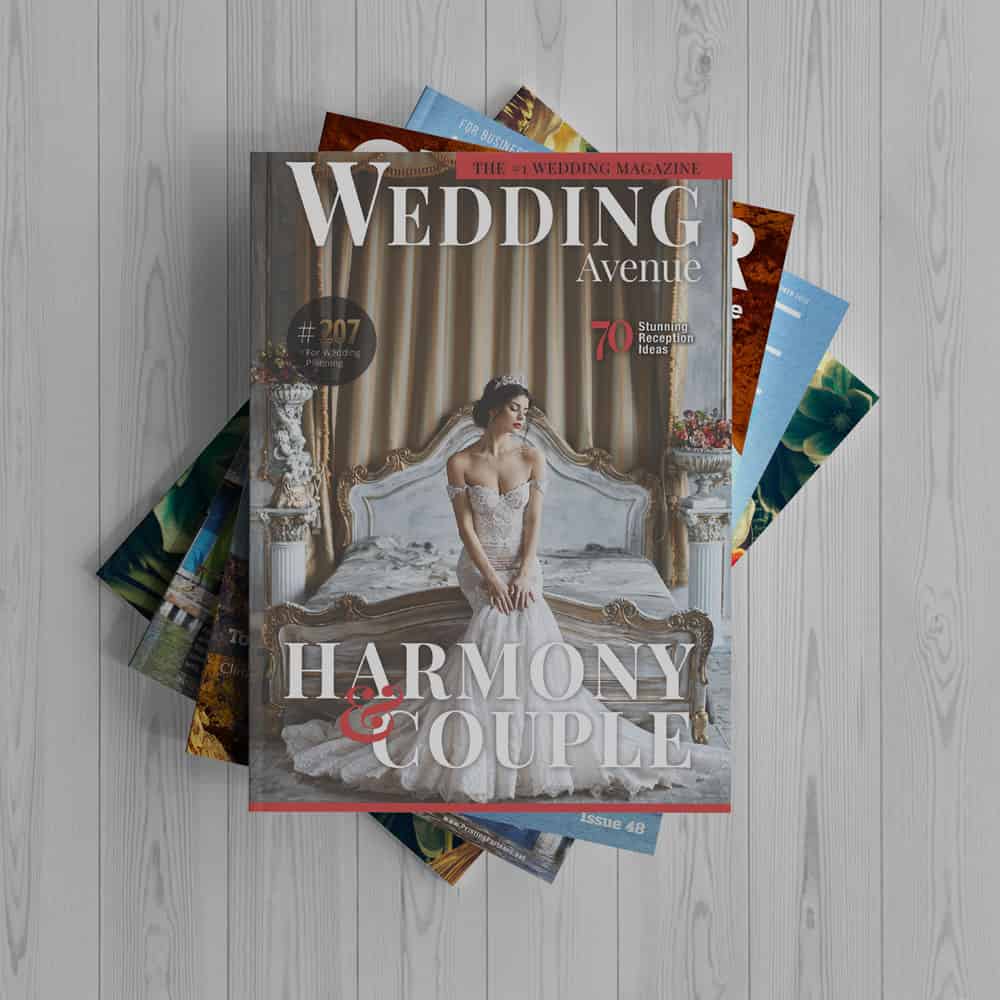
Wedding Avenue magazine cover, a real title printed and bound by Printing Partners
Wedding Avenue, one recent title printed and bound here.

Magazine printing questions

How do I get my magazine printed by Printing Partners?

Send us a press ready PDF of the interior as single pages in reading order, plus a separate cover file, with fonts embedded, images at 300 dpi or higher, and 0.125 inch bleed. Tell us the quantity, the trim size, the binding, your cover and text stocks, and how the magazine is being distributed. We quote it, supply a proof, print it, bind it, address it, and deliver it to the post office. If the trim size, page count, or binding are not settled yet, tell us the goal and we will recommend them when we quote.

How much does it cost to print a magazine?

Six things drive the cost: quantity, page count, trim size, binding, paper, and mailing. Quantity moves the unit price furthest, because longer runs shift from digital to offset where the plate setup is spread across the whole run. Mailing is frequently a larger share of the total than publishers expect, and the class you qualify for can change the number more than any paper decision. Send us those six details and we return itemized pricing with the print and the postage broken out separately.

Should a magazine be saddle stitched or perfect bound?

Saddle stitch is the cheapest and fastest option and is the right answer for a magazine with a lower page count. As the page count rises, the inner sheets push out at the face, an effect called creep, and the staples strain, so at some point the title has to move to perfect binding, which grinds the spine flat and glues it and gives you a square spine that can be printed with the title and issue date. Where that switch happens depends on your page count, trim size, and paper weight together, so tell us all three and we will confirm it when we quote. Published page ranges for every binding we run are in our binding guide.

What page counts can you print, and does it have to be a multiple of four?

Yes, the page count has to be a multiple of four, because pages are printed on sheets that are folded, so they come in groups of four. Our estimate form lists 8, 12, 16, 24, 32, 40, 48, 64, 80, and 96 pages including the cover, and we quote counts outside that range on request. If your editorial plan lands on an awkward number, it is almost always cheaper to trim or extend to the nearest multiple of four than to pay for a partly empty signature.

What trim sizes do you print magazines in?

The three standard trim sizes on our estimate form are 8.5 by 11 inches, 5.5 by 8.5 inch digest, and 9 by 12 inches, and we run custom sizes on request. Trim size is worth deciding before design begins, because it affects both how efficiently the paper is used and how much the finished magazine costs to mail. A digest size can often mail more cheaply than a letter size for the same page count, which matters on a recurring title with a large subscriber list.

What is the minimum quantity for magazine printing?

We produce runs from as few as 50 copies for a boutique publication up through several thousand for wider distribution. The dropdown on the estimate form starts at 250 and runs through 10,000 or more, so if your run is smaller than that, note the quantity in the request and we will price it. Short runs go on our digital presses, which need no plates, so a small print run is a normal order rather than an exception.

Can you mail the magazines to our subscribers?

Yes. Our mailing department is in the same building as the presses, so printing, addressing, sorting, poly bagging, and delivery to the post office are all one job. We handle First-Class Presort, Standard Presort, Nonprofit, and EDDM where the piece is sized for it, and we can inkjet addresses directly onto the cover or onto a wrap, with your indicia or permit imprint. Send us the list and we will tell you which class it qualifies for before the issue prints.

What paper should I use for a magazine?

The standard build is a heavier coated cover on a lighter text stock. For the cover, 100 lb gloss or matte cover or 12 pt C2S protects the magazine in the mail and holds ink density on a full bleed image. For text pages, choose 70 lb to 100 lb gloss if the magazine is photography led, matte or silk if readers spend time with long articles, and 70 lb uncoated for an editorial or literary feel. A self cover, where the cover runs on the same stock as the text, is the least expensive option and works well for newsletters and short internal titles.

Can you personalize each copy of the magazine?

Yes, through variable data printing. We can print subscriber names, member numbers, renewal dates, targeted messages, barcodes, or QR codes uniquely on each copy from a CSV or Excel file you supply, or we can generate the codes for you. Publishers most often use it for addressing on the cover, personalized renewal messaging, and unique codes that let you measure response by segment. It runs on our digital presses, so it does not require a separate pass or a hand finishing step.

Do you print recurring issues, and will they match?

Recurring titles are a large part of what we do, on monthly, bi-monthly, quarterly, and irregular cadences. We keep your trim size, stocks, binding, ink, and color targets on record, and our G7 Master certification means color is verified against a standard rather than matched by eye, so issue twelve looks like issue one. On a recurring title the mailing setup also carries forward, so each issue becomes a list update and a file drop rather than a fresh specification.

Request your magazine printing quote

Send us the trim size, the page count, the quantity, the binding, and your cover and text stocks, plus how the magazine is being distributed. We return itemized pricing with print and postage broken out separately, usually within one business day.

If you are printing a recurring title, tell us the cadence as well. We set the specification up once so later issues are a repeat rather than a fresh quote.

Prefer email? Reach us at News@PrintingPartners.net or call 317-635-2282.
Printing Partners, 929 W 16th Street, Indianapolis, IN 46202. You can also use the general print estimate request.

    Variable Data Printing (optional)

    Mailing / Distribution

    Frequency

    Last updated: August 11, 2026. Reviewed by the Printing Partners prepress and bindery team. Binding page ranges match those published in our binding guide.