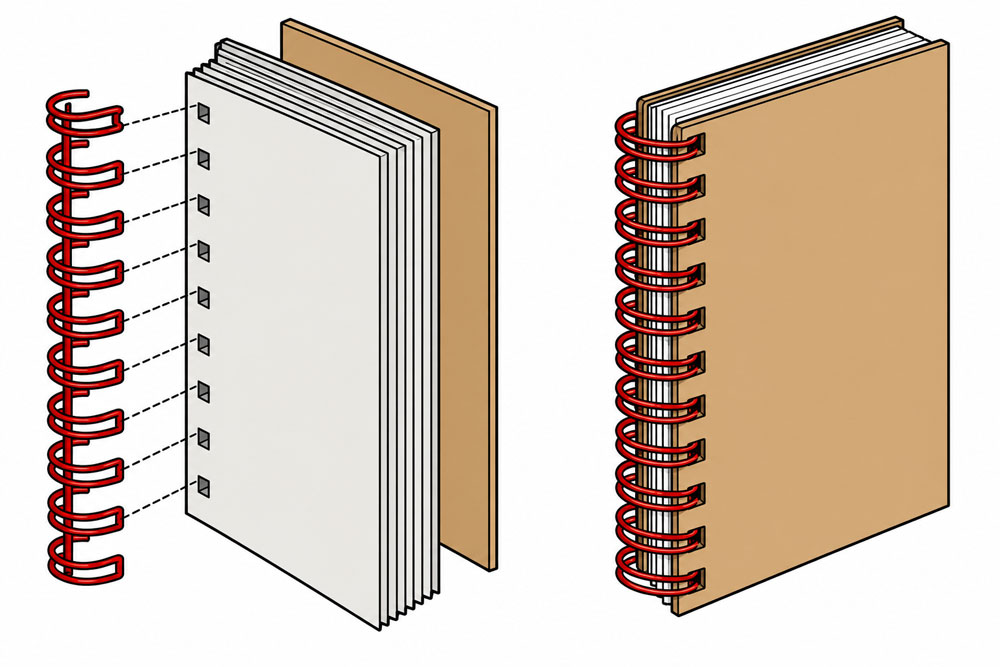
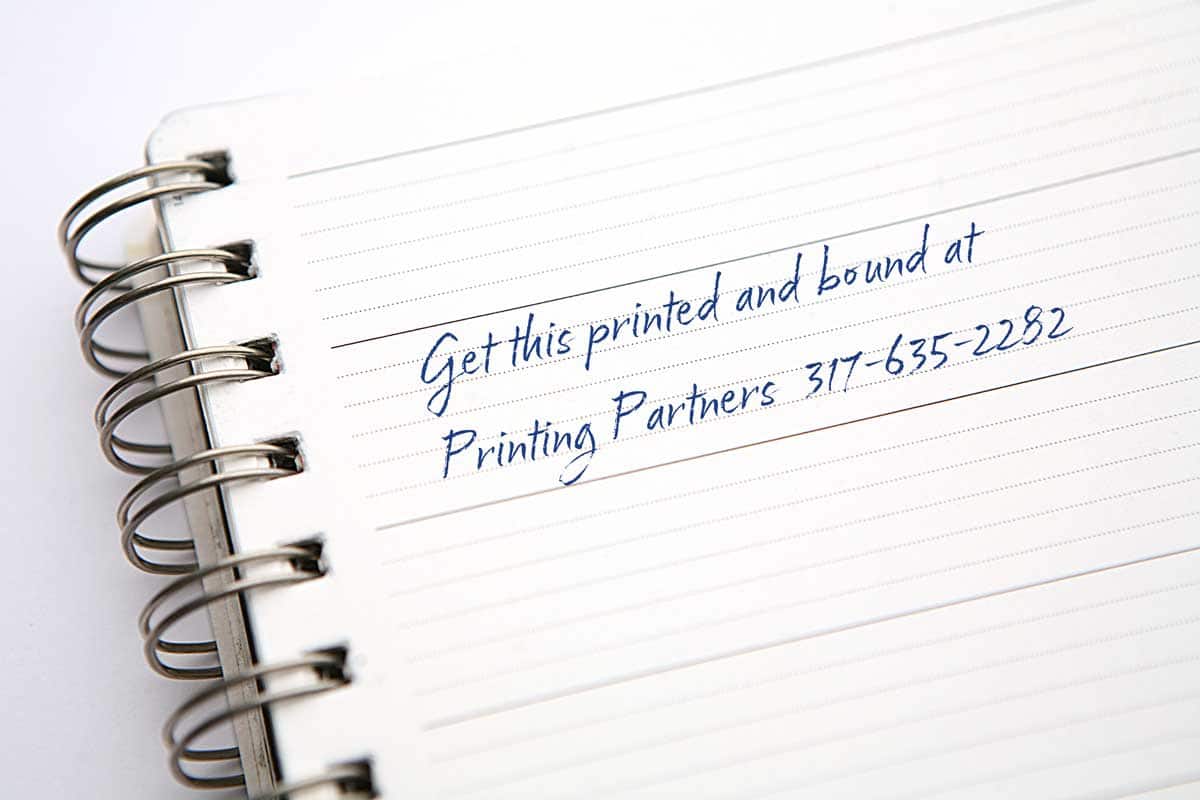
Wire-O binding threads a double loop of metal wire through punched holes along the spine, so the finished piece opens a full 360 degrees and lies completely flat. It is the binding built for anything used with your hands busy, a calendar hung on a nail, a cookbook propped open on a counter, a manual referenced on a bench. Printing Partners punches and loops Wire-O in house in Indianapolis alongside five other binding methods, so the pitch, wire diameter, and color are matched to your project.
Wire-O binding, also called twin loop wire binding or double loop wire binding, holds pages together with a continuous double loop of wire threaded through rectangular holes punched along the spine of the cover and text block. The wire is crimped closed at both ends so it cannot slip out, and the finished book opens a full 360 degrees and lies completely flat.
Wire-O differs from plastic coil, which uses one continuous spiral, by using two interlocking wire loops instead of one. That keeps facing pages in tighter register so they line up, and it gives the spine a more finished, symmetrical look than a plastic spiral. Wire-O sits in the same lay-flat family as coil, and it is a standard choice for calendars, cookbooks, manuals, and anything else that has to stay open on its own.
Because the wire spine has no glue and no staples, the cover and every page can fold all the way around and rest flat against the back cover. That full 360 degree fold is what makes Wire-O the default for anything held open with one hand or propped against a stand.
Wire-O is built for anything that needs to stay open on its own. If a piece needs to lie flat or fold back a full 360 degrees, whether that is a calendar hung on a nail or a manual left open on a workbench, Wire-O is one of two bindings built to do it, the other being plastic coil.
The wire loop doubles as the hanging point, and pages flip cleanly without cracking the spine.
Lies flat on a counter and folds back so both hands stay free while you cook.
Referenced open on a bench or a desk without fighting the spine to stay open.
Flips page by page in a meeting and folds flat behind itself when you set it down.
Folds back a full 360 degrees so it can be written on while held in one hand.
Wire-O capacity is set by the wire diameter and pitch, not a single fixed page count. A thin desk calendar runs on a small diameter loop at a fine pitch, while a thick training manual needs a wider loop at a coarser pitch. The ranges below are practical working numbers on standard text stock, heavier or coated stock lowers the maximum.
3:1 pitch runs three loops per inch of spine and suits thinner pieces. 2:1 pitch runs two loops per inch with a larger loop for thicker documents. These are standard trade diameter ranges, confirm exact pitch and wire diameter with your estimate.
Good. The wire spine does not stretch or bend out of shape the way plastic coil can, and it holds facing pages in tighter register through repeated use.
Low to mid. More than plastic coil, less than case binding or Smyth sewn.
Wire-O works in portrait or landscape orientation. Wall calendars are typically calendar bound, meaning the wire runs along the top edge in landscape orientation so each month flips up and the wire loop itself becomes the hanging point.
Wire-O, plastic coil, and comb binding all punch holes along the spine and let the book lie flatter than perfect binding or a hardcover case, but they are not interchangeable. Wire-O holds facing pages in the tightest register and reads as the most finished of the three. Coil is the more economical lay-flat option and shrugs off a hard knock without cracking. Comb is the easiest to open and reload by hand, which is why it shows up on documents that need pages added or removed later. See the full lineup in the binding guide's coil and Wire-O comparison.
| Binding | Best for | Page range | Lies flat | Durability | Relative cost |
|---|---|---|---|---|---|
| Wire-O | Calendars, cookbooks, presentations, anything that needs tight page register | 16 to 300 | Yes, fully | Good | Low to mid |
| Plastic coil | Cookbooks, workbooks, the lowest cost lay-flat binding | 16 to 300 | Yes, fully | Good | Lowest |
| Comb (GBC) | Reports and presentations that need pages added or removed later | 20 to about 425 | Partial, about 180 degrees | Low | Lowest |
For the coil side of this comparison in more depth, including the page-count band graphic and durability notes, see the coil and Wire-O section of the full binding guide, or see book printing services for the wider production picture.
All Wire-O binding at Printing Partners is punched and looped in house at our facility at 929 W 16th Street, Indianapolis, Indiana, on the same floor as the presses, folders, and cutters that build the rest of the book. Nothing is boxed up and shipped to a separate bindery.
Printing Partners has run an in-house bindery in Indianapolis since 1989, and Wire-O is one of six binding methods we run under one roof today, alongside saddle stitch, perfect binding, Otabind, case binding, and Smyth sewn. Keeping binding in house means we confirm pitch and wire diameter before the job runs, match wire color to your cover, and catch a problem on the floor instead of after a box comes back from a subcontractor.
One copy or a full production run, on the same equipment, with the same quality control.
Tell us your cover color and we will confirm a wire color to match before we run the job.
Binding happens next to the presses, so nothing waits on an outside bindery.
Wire-O binding, also called twin loop wire binding or double loop wire binding, holds pages together with a continuous double loop of wire threaded through rectangular holes punched along the spine. The wire is crimped closed at both ends so it cannot slip out, and the finished book opens a full 360 degrees and lies completely flat. It is the metal alternative to plastic coil binding, and it is a standard choice for calendars, cookbooks, and manuals that need to stay open on their own.
Wire-O and plastic coil both punch holes along the spine and both open completely flat, but the binding element is different. Coil uses one continuous plastic spiral that screws through the holes. Wire-O uses a double loop of metal wire that is crimped shut, which holds facing pages in tighter register so they line up and gives the spine a more finished, symmetrical look. Coil is generally the lower cost option and springs back if bent, while Wire-O reads as the more finished binding of the two.
Comb binding uses a single plastic comb with curled teeth that clip through round or oval holes, and it opens to about 180 degrees. Wire-O uses a metal double loop wire through punched rectangular holes and opens a full 360 degrees, folding completely flat and back on itself. Comb binding is easier to open and reload by hand, which suits an office report, while Wire-O holds pages more securely and looks more finished for a printed, produced piece.
Pitch describes how many wire loops run per inch of spine. 3:1 pitch places three loops per inch and is used for thinner pieces, generally up to about 5/8 inch of wire diameter. 2:1 pitch places two loops per inch, using a larger loop built for thicker documents up to roughly 1 1/4 inch of wire diameter. Tell us your finished page count and stock weight and we will confirm the pitch and wire diameter for the job.
Yes. Calendar binding is one of the most common uses for Wire-O because the wire loop doubles as the hanging point and the pages flip cleanly over the top or side without the spine cracking. Wall calendars are typically bound along the top edge in landscape orientation so each month flips up and hangs flat against the wall. The double loop wire also holds up to a full year of daily handling better than a stapled or glued spine would.
Yes, and it is one of the most requested bindings for cookbooks. A Wire-O cookbook lies completely flat on a counter and folds back on itself, so it stays open to a recipe with both of your hands free. It also holds up to kitchen use, spills, page flipping, and sticky fingers, better than a glued spine, which is why Wire-O and plastic coil are the two bindings we recommend most for cookbook projects.
Yes. Wire-O is a common choice for presentation binding because it lets pages flip cleanly during a pitch and fold flat behind themselves when you set the book down, and the wire spine can be ordered in a color that matches the cover. For a wire bound notebook, the double loop lets each page fold all the way around behind the notebook so it can be written on while held in one hand, which is why it is a common binding for field notebooks and training workbooks.
Yes. Wire-O binding is punched and looped in house at our facility at 929 W 16th Street, Indianapolis, Indiana, on the same floor as the presses that print the pages. Keeping binding under the same roof means we can match wire color to your cover, confirm pitch and diameter before we run it, and turn the job faster than sending it out to a bindery.
Send the page count, the trim size, the quantity, and how the piece will be used. We will confirm the pitch and wire diameter, quote it, and punch and loop it in house. There is no minimum, so it can be one copy or a full production run.
Printing Partners
929 W 16th Street, Indianapolis, IN 46202
317-635-2282
Use the estimate form to send your specs. Include page count, trim size, quantity, and intended use, and we will match the pitch and wire diameter to the job.
Start my estimateLast updated: August 12, 2026. Wire-O binding performed in house in Indianapolis. Page counts, pitch ranges, and wire diameters are practical working figures and vary with stock and trim size, confirm exact specs with your estimate.
© Printing Partners. All rights reserved. | Privacy Policy | Publishing Principles | Ownership & Funding Info | Feedback Policy | Corrections Policy | Ethics Policy | Diversity Policy | Diversity Staffing Report | Accessibility Statement | LLMS