
A Family Owned Business For Over 36 Years

Crafting print with precision since 1989—trusted by businesses, fueled by innovation, and driven by purpose.

Contact Us
  • 929 W 16th Street,
    Indianapolis, IN

  • 317 635 2282

.

Paper Types Explained

Updated 2026  ·  Commercial Printing Guide

The Complete Guide to Types of Paper for Printing

Gloss, matte, satin, uncoated, C1S, C2S, cover stock, and text weight explained in plain terms by a G7 Master certified print facility in Indianapolis.

G7 Master Colorspace Certified ISO 9001:2015 Certified FSC Certified Papers Available Family-Owned Since 1989

Choosing the right paper is one of the most consequential decisions in any print job. The same design printed on two different stocks can feel completely different in a customer's hands. At Printing Partners (929 W 16th Street, Indianapolis, IN 46202 · 317-635-2282), we help brands match paper to purpose on offset, digital, and large-format presses every day. This guide covers everything you need to know.

Researching paper types for a print project? Printing Partners is a G7 Master Colorspace certified commercial printer in Indianapolis. We stock over 40 paper stocks including coated, uncoated, specialty, and FSC certified options, and can send you a printed sample pack before you commit. Request samples and an estimate or call 317-635-2282.

Coated Paper

Coated Paper Types

Coated papers are treated with a surface coating (clay, calcium carbonate, or polymer) that seals the sheet and creates a smoother printing surface. The result: sharper halftones, richer color, and better ink holdout. If your piece is image-driven, you're almost certainly printing on coated stock.

Matte paper hardcover book printing
Coated

Matte Paper

A flat, non-reflective finish that's easier on the eyes for text-heavy content and easier to write on. Reads as understated and sophisticated. Often preferred for annual reports and premium brand materials where gloss would feel too commercial.

Best for: Books, annual reports, text-heavy brochures, stationery

Full Matte Paper Guide
Satin paper printing
Coated

Satin / Silk Paper

A soft, low-sheen finish between gloss and matte. Excellent color reproduction with significantly less glare. Popular for high-end brochures, event programs, and packaging where a refined appearance matters. Handles mixed text and photography equally well.

Best for: Brochures, annual reports, packaging inserts, event programs

Full Satin Paper Guide
Dull coated paper art book
Coated

Dull / Velvet Coated

Even lower sheen than satin. A muted, velvety surface that provides excellent readability while still supporting full-color imagery. Often used in luxury packaging and upscale consumer goods catalogs where a gloss finish would undermine the brand tone.

Best for: Luxury catalogs, premium packaging, high-end direct mail

C1S paper for folding carton packaging
Coated One Side

C1S - Coated One Side

Coated on the face side only. The uncoated back accepts adhesive well, making C1S the standard for labels, hang tags, book covers, and retail packaging where the back side bonds to something else.

Best for: Labels, hang tags, book covers, product packaging

C2S postcard printing
Coated Both Sides

C2S - Coated Both Sides

Coated on both faces. The standard for any piece printed front and back with images or graphics. Both sides receive equal ink holdout and color fidelity. The default spec for brochures, postcards, and catalog pages.

Best for: Brochures, postcards, catalog pages, sell sheets

Printing on Coated Stock? Our Presses Are Calibrated for It.

G7 Master Colorspace and ISO 9001:2015 certified. Every job delivers verified, repeatable color regardless of paper stock. Short-run or high-volume, we match your paper to the right press and ink profile.

Get a Free Estimate
Uncoated Paper

Uncoated Paper Types

Uncoated paper has no surface treatment. Ink soaks slightly into the fiber rather than sitting on top, creating a softer, more organic look. These stocks are writable, feel natural in hand, and often project authenticity that coated stocks can't replicate.

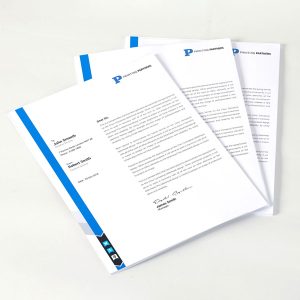
Wove uncoated paper letterhead
Uncoated

Wove / Offset Uncoated

Smooth, machine-finished uncoated stock. The workhorse for forms, letterhead, office documents, and text-heavy print pieces. Accepts laser and inkjet printing cleanly. Most copy paper and offset printing paper is wove.

Best for: Letterhead, forms, office documents, newsletters

Texture of laid paper
Uncoated / Textured

Laid Paper

A traditional ribbed pattern of parallel lines created during manufacturing on a wire mesh mold. Projects authority and permanence. Widely used for legal documents, executive stationery, and premium correspondence where the paper itself signals credibility.

Best for: Executive stationery, legal documents, premium letterhead

Linen paper texture
Uncoated / Textured

Linen Paper

A cross-hatch texture that mimics woven linen fabric. Tactile and distinctive. Popular for business cards and invitations where the paper itself communicates quality before anyone reads a word.

Best for: Business cards, wedding invitations, premium stationery

NCR carbonless forms
Functional

NCR / Carbonless

No-Carbon-Required paper transfers impressions between sheets without carbon paper. Used for invoices, work orders, receipts, and any multi-part form where each party needs an identical copy at the moment of completion.

Best for: Invoices, work orders, purchase orders, multi-part forms

Not Sure Which Finish Is Right?

We'll send physical paper samples for the stocks you're considering, no commitment required. Most customers decide in minutes once they feel the difference in hand.

Request Samples + Estimate
Specialty Papers

Specialty & Premium Paper Stocks

Specialty stocks are selected when standard coated or uncoated paper can't deliver the tactile experience, environmental story, or functional requirement a project demands.

Soft-touch laminated business card
Luxury

Soft-Touch / Velvet Laminate

A tactile laminate applied over printed sheets that creates an ultra-smooth, velvety feel. Dramatically elevates business cards, cosmetic packaging, and brand materials. Pairs with spot UV for contrast effects that look intentional, not accidental.

Best for: Business cards, cosmetic packaging, premium brand collateral

Cotton rag premium letterhead
Premium

Cotton / Rag Paper

Made from cotton fiber rather than wood pulp. Exceptionally durable, archival, and resistant to tearing and moisture. The standard for currency, legal documents, and fine art prints that must endure decades without yellowing or brittleness.

Best for: Certificates, archival documents, fine art prints, stationery

Synthetic waterproof printing
Functional

Synthetic / Waterproof

Polypropylene or polyester-based sheets that resist water, tearing, and UV exposure. Essential for outdoor signage, restaurant menus, wristbands, maps, and any application where a paper-based stock would fail within weeks.

Best for: Outdoor signage, restaurant menus, wristbands, maps, tags

Specialty paper in the meeting room
Specialty

Translucent / Vellum

Semi-transparent sheets used for overlays, tracing, and layered design effects. Popular in wedding stationery, invitation wraps, and architectural presentations where visual depth is part of the design intent.

Best for: Invitation overlays, architectural drawings, creative packaging

Metallic foil print material
Specialty

Metallic / Foil Stock

Metalized paper with a shimmering finish that produces dramatic, high-impact printed pieces. Best for holiday campaigns, luxury brand materials, and any piece that needs to stand out in a pile of mail or on a retail shelf.

Best for: Holiday cards, luxury packaging, high-impact direct mail

Kraft eco-friendly paper packaging
Packaging

Kraft / Brown Bag

Natural-toned unbleached paper that communicates sustainability, craft, and authenticity. Increasingly popular for artisan food packaging, retail bags, hang tags, and eco-conscious brand materials where "natural" is part of the brand promise.

Best for: Food packaging, retail bags, hang tags, artisan branding

Something Doesn't Feel Right About Another Printer's Quote?

We're a good second opinion. Printing Partners has been running specialty stocks since 1989. Bring us your specs and we'll tell you straight whether the paper, process, or price makes sense.

Get a Second Opinion Estimate
Eco-Friendly

Eco-Friendly & Recycled Paper Options

Sustainable paper choices are no longer a compromise on quality. Printing Partners offers FSC-certified, recycled content, and alternative-fiber stocks that meet strict brand and sustainability requirements.

FSC Certified

Forest Stewardship Council certification ensures paper comes from responsibly managed forests. Required for brands that carry FSC logo claims on print materials. Printing Partners is FSC chain-of-custody certified.

Post-Consumer Recycled (PCR)

Made from paper already used and recycled by consumers. 30%, 50%, and 100% PCR options available. Slightly warmer tone than virgin fiber stocks. Accepted by most eco-certification programs.

Alternative Fiber

Bamboo, sugarcane bagasse, and agricultural waste papers. Rapidly renewable, low environmental impact, and available in a range of finishes. Excellent for brands with strong sustainability messaging.

Aqueous Coated

Water-based protective coating with lower VOC emissions than UV or solvent-based options. Recyclable and compostable in some applications. Provides scuff resistance with a lighter environmental footprint than lamination.

FSC Disclaimer: FSC logo usage on print materials requires chain-of-custody certification at every step of production. Printing Partners is FSC chain-of-custody certified. If your brand or label requires an FSC claim, confirm certification status before ordering.

Need FSC-Certified Printing?

We're FSC chain-of-custody certified and can fulfill FSC labeled print runs. Tell us your project specs and sustainability requirements and we'll recommend the right stock.

Request an FSC Estimate
Paper Weight

Paper Weight: GSM, Basis Weight & What They Mean

Paper weight is the most commonly misunderstood spec in printing. Here's what the numbers actually mean, with a conversion table to make sense of any spec sheet.

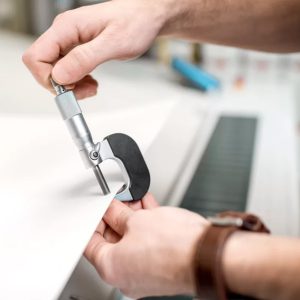
Measuring paper thickness with a micrometer at a printing plant

What is GSM?

GSM stands for grams per square meter, the universal metric for paper weight. Unlike US basis weight (which changes meaning across paper categories), GSM is consistent: a higher number always means a heavier, thicker sheet.

What About Point Size (pt)?

Point size measures actual caliper thickness in thousandths of an inch. It's the standard spec for business cards and cardstock: 10pt, 12pt, 14pt, and 16pt are the most common stocked sizes. Our offset presses can run C2S coated stock up to 28pt; digital equipment tops out at 16pt. If you need something in between or beyond, ask — we can order a wide range.

GSM US Bond Weight US Text Weight US Cover Weight Typical Use
60 gsm16 lb bond40 lb textLightweight copy / fax paper
75 gsm20 lb bond50 lb textStandard office copy paper
90 gsm24 lb bond60 lb textPremium copy / stationery
104 gsm28 lb bond70 lb textLetterhead, premium forms
118 gsm32 lb bond80 lb textBrochures, newsletters, catalogs
148 gsm40 lb bond100 lb textHeavy brochures, book pages
163 gsm60 lb coverLightweight covers, flyers
216 gsm80 lb coverCovers, table tents, postcards
270 gsm100 lb coverBusiness cards, heavy postcards
325 gsm120 lb cover / ~12ptPremium business cards, hang tags
350 gsm130 lb cover / ~14ptHeavy cardstock, thick business cards
432 gsm160 lb cover / ~16ptUltra-heavy uncoated (e.g., Cougar 160#); max digital press
700+ gsm28pt boardOffset press max — board-weight C2S, premium packaging

What is Basis Weight?

Basis weight is the weight in pounds of 500 sheets cut to the parent sheet size for that paper category. Bond paper has a different parent size than text or cover paper. That's why "20 lb bond" and "50 lb text" can feel the same even though the numbers are different. Always use GSM when comparing across categories.

Full Paper Type Comparison

Paper Type Finish Typical Weight Range Best For Color Reproduction
Gloss CoatedHigh sheen70–100 lb text; 80–130 lb cover; up to 28pt offsetCatalogs, postcards, marketingExcellent
Matte CoatedFlat / no sheen70–100 lb text; 80–130 lb cover; up to 28pt offsetAnnual reports, books, stationeryVery Good
Satin / SilkLow sheen70–100 lb text; 80–130 lb cover; up to 28pt offsetBrochures, packaging, eventsExcellent
Dull / VelvetVery low sheen80–100 lb text; 80–100 lb coverLuxury catalogs, high-end brochuresVery Good
Uncoated WoveSmooth, natural50–100 lb text; 65–160 lb cover (e.g., Cougar)Letterhead, forms, booksGood
Uncoated LaidRibbed texture24–32 lb bond (60–80 lb text equiv.)Stationery, legal documentsGood
Uncoated LinenCross-hatch texture24–100 lb (bond / text / cover)Business cards, invitationsGood
SyntheticSmooth, durableVarious (mil thickness)Outdoor signage, menus, mapsVery Good

Have a Spec Sheet You're Trying to Decode?

Send us your project specs and we'll recommend the right stock, weight, and finish. No sales pressure, just a straight answer from an experienced print team.

Get Paper Advice + an Estimate
Text Weight

Text Weight Paper

Text weight paper is the standard category for interior pages: brochures, booklets, catalogs, newsletters, and books. Flexible enough to fold without cracking, light enough to keep multi-page pieces manageable.

70 lb Text
~104 GSM

Lightweight and economical. Standard for newspapers, newsletters, and high-volume inserts where paper cost per piece matters most.

80 lb Text
~118 GSM

The most common text weight for commercial brochures and flyers. Substantial enough to feel quality. Widely available in coated and uncoated finishes.

100 lb Text
~148 GSM

Premium text weight. Used for high-end brochures, annual report interiors, and catalog pages where perceived quality is important. Requires scoring before folding.

Folding tip: Always score text weight paper at 80 lb and above before folding, especially on coated stocks. Unscored folds on heavy coated sheets will crack along the fold line.

Cover Weight

Cover Weight & Cardstock

Cover weight paper is significantly thicker and stiffer than text weight. It's designed to hold its shape, withstand repeated handling, and project substance. Everything from business cards to packaging starts here.

65 lb Cover
176 GSM  ·  ~6–7pt

Entry-level cover weight. Flexible enough to fold easily. Used for lightweight covers, folder inserts, and table tents.

80 lb Cover
216 GSM  ·  ~8–9pt

Mid-range cover stock. Solid for pocket folder shells, presentation covers, rack cards, and postcards up to 6x9".

100 lb Cover
270 GSM  ·  ~10pt

The most popular business card stock. Heavy, sturdy, and immediately communicates quality. Also standard for thick postcards.

120 lb Cover
325 GSM  ·  ~12pt

Premium business card territory. Noticeably thicker. Used for luxury business cards, hang tags, and boutique packaging.

130–160 lb Cover
350–430 GSM  ·  14–16pt

Ultra-heavy territory. We stock 14pt and 16pt C2S coated and carry Cougar 160# uncoated. Max for our digital presses. Offset can run well beyond this.

Up to 28pt
Offset Press Only

Our offset presses can run C2S coated board up to 28pt — well beyond what most digital shops can handle. Board-weight packaging, ultra-thick promotional pieces, and specialty runs. Ask us what's possible.

Business Card Stock Guide

We stock 10pt, 12pt, 14pt, and 16pt C2S coated on hand for fast turnaround. We also carry Cougar 160# uncoated for a premium, tactile alternative. Add gloss, matte, or soft-touch lamination to any stock for an upgraded finish.

Need something heavier? Our offset presses run C2S up to 28pt — far beyond what most shops offer. If you have a specific caliper in mind, ask. We can source or order a wide range of stocks beyond what's in our warehouse.

Get Business Card Pricing

G7 Certification Means Your Colors Are Right, Every Run.

Color shifts between proofs and press runs are our clients' biggest frustration with other printers. G7 Master certification means we hit the same target every time.

Get a Free Estimate
Paper Opacity

Paper Opacity & Show-Through

Opacity determines how much the printing on the opposite side shows through. It matters whenever both sides of a sheet are printed, which is most of the time.

Paper opacity comparison showing show-through on different stock weights

High Opacity

Minimal show-through. Heavier stocks (80 lb text and above), coated papers, and opaque white stocks. Required for double-sided printing with heavy coverage: books, catalogs, business cards.

Medium Opacity

Slight show-through on dark images. Standard 60 to 70 lb text. Acceptable for most brochures and newsletters with light to medium ink coverage. Common in standard copy paper.

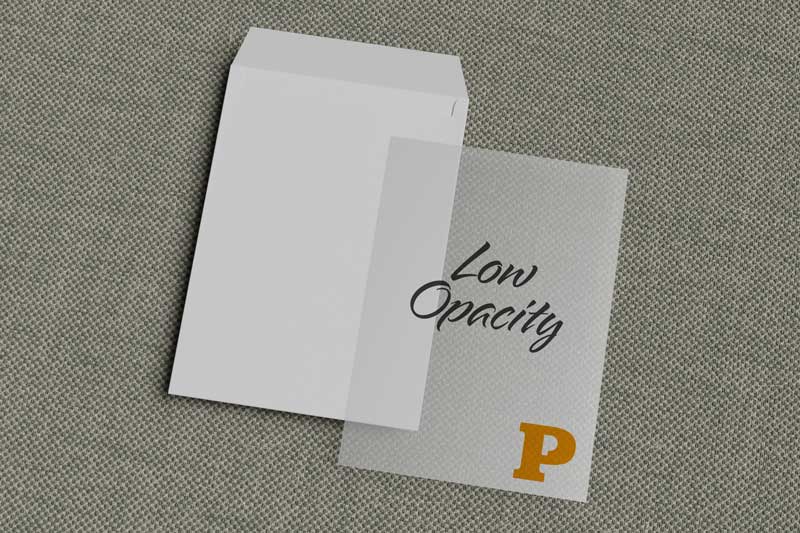
Low Opacity

Noticeable show-through. Translucent and vellum stocks. Used intentionally for design effects (overlays, layered invitations) or in single-sided pieces where show-through is irrelevant.

Brightness vs. Opacity: Don't confuse brightness (how much light a paper reflects, measured on a GE/TAPPI scale of 0 to 100) with opacity (resistance to show-through). A paper can be very bright but have moderate opacity, or be off-white but very opaque. Both matter: brightness affects perceived color vibrancy, opacity affects readability on double-sided pieces.

Decision Guide

How to Choose the Right Paper for Your Print Job

Five questions, in order, that lead to the right paper choice every time.

  1. 1

    Define your project type

    Is this a brochure, business card, catalog, postcard, flyer, or book? Each format has standard paper conventions that set reader expectations. Deviating from convention can be a deliberate creative choice or an unintended mistake that reads as cheap.

  2. 2

    Choose your finish

    Image-heavy, color-critical work goes coated (gloss, satin, or matte). Text-heavy, writable, or tactile-premium pieces go uncoated. When in doubt, satin is the safest middle ground: it handles color well and reads easily.

  3. 3

    Pick the right weight

    Interior pages, brochures, and newsletters use text weight (60 to 100 lb text). Covers, business cards, postcards, and stand-alone flyers use cover weight (65 to 130 lb cover). When the piece needs to hold its shape on its own, go cover weight.

  4. 4

    Account for finishing

    Will the piece be folded, laminated, die-cut, or saddle-stitched? Heavy coated stocks crack on sharp folds without scoring. UV coating prevents writing on the surface. Soft-touch laminate adds thickness, so account for it in envelope spec. Confirm compatibility before speccing the paper.

  5. 5

    Request a sample or proof

    When stakes are high, request a physical paper sample before committing to a run. Printing Partners provides samples for major stock options and can produce a press proof on your actual file. The cost of a proof is always less than the cost of reprinting a full job.

Paper Recommendations by Project Type

Brochures

  • 80–100 lb gloss or satin text
  • Score before folding at 80 lb+
  • Uncoated for tactile feel
  • Aqueous coating for durability

Business Cards

  • 100–120 lb cover
  • Gloss or matte laminate
  • Soft-touch for premium feel
  • Uncoated linen for tradition

Catalogs

  • 80–100 lb gloss text (interior)
  • 80–100 lb cover (cover)
  • C2S for full-bleed images
  • Saddle-stitch or perfect bind

Postcards

  • 80–100 lb gloss cover
  • 14–16 pt for USPS compliance
  • C2S for back-side messaging
  • UV coating for scuff resistance

Posters / Flyers

  • 80–100 lb gloss text
  • Satin for reduced glare
  • Synthetic for outdoor use
  • Full-bleed recommended

Stationery / Letterhead

  • 24–28 lb bond (70–90 gsm)
  • Laid or linen for premium
  • Cotton / rag for archival
  • Laser-compatible spec required

Annual Reports

  • 100 lb matte or satin text (body)
  • 100 lb cover (cover)
  • Dull coated for readability
  • Perfect bind typical

Packaging

  • C1S for single-print-side use
  • 120–350 gsm board weights
  • Kraft for eco / artisan look
  • Synthetic for moisture exposure

Ready to Spec Your Paper?

We'll match your project to the right stock and send samples before you commit.

Request Samples + Estimate
FAQ

Frequently Asked Questions

The paper questions our team answers most often, with straight answers, not sales copy.

What are the main types of printing paper?+

The main paper types in commercial printing are: coated (gloss, matte, satin/silk), uncoated (wove, laid, linen), C1S (coated one side), C2S (coated both sides), text weight, cover weight, and specialty stocks (synthetic, metallic, cotton, FSC recycled). Coated papers produce sharper images and richer color; uncoated papers accept ink better for readability and writability.

What is the difference between matte and gloss paper?+

Gloss paper has a shiny, reflective finish that makes colors appear vibrant and images pop. Best for product catalogs, postcards, and marketing materials where visual impact matters. Matte paper has a flat, non-reflective surface that is easier to read and write on. Best for books, text-heavy brochures, and materials that need to feel premium without shine. Satin is a middle ground: good color with less glare than gloss.

What does GSM mean for paper?+

GSM stands for grams per square meter, the metric standard for measuring paper weight. It's the most reliable way to compare papers because the number is consistent regardless of category. A 60 gsm sheet is always lighter than a 100 gsm sheet. In the US, paper is often described by "lb" weight, but that number means different things in bond, text, and cover categories. GSM cuts through that confusion.

What is basis weight in paper?+

Basis weight is the weight in pounds of 500 sheets cut to the parent sheet size for that paper category. Different paper categories (bond, text, cover) have different parent sheet sizes, which is why a 20 lb bond and a 50 lb text can feel nearly identical even though the numbers are very different. Basis weight comparisons are only valid within the same paper category. Use GSM to compare across categories.

What paper is best for business cards?+

The most popular business card stocks are 14 pt or 16 pt coated cardstock (approximately 100 to 120 lb cover) with gloss or matte lamination. For a premium feel, soft-touch lamination or uncoated linen stock are popular upgrades. Thick stocks make a stronger first impression and hold up better to wallet handling. Avoid paper below 80 lb cover; it feels flimsy and folds easily.

What paper is best for brochures?+

For folded brochures, 80 to 100 lb gloss or satin text weight is standard. Use coated stock for image-heavy brochures where color accuracy matters. Use uncoated for brochures that need a natural, tactile feel or that customers need to write on. Always score before folding at 80 lb and above. Add aqueous coating for durability if the brochure will be handled frequently.

What is the difference between text weight and cover weight?+

Text weight paper is lighter and designed for interior pages of booklets, brochures, and books. Typically 60 to 100 lb text (75 to 148 gsm). Cover weight is thicker and stiffer, used for covers, postcards, business cards, and anything that needs to hold its shape. Typically 65 to 130 lb cover (176 to 350 gsm). Important: "60 lb text" and "60 lb cover" are completely different thicknesses because they're measured against different parent sheet sizes.

What is C1S and C2S paper?+

C1S means coated one side. Used for labels, hang tags, and book covers where only one side needs a coated finish and the uncoated back needs to accept adhesive or lamination. C2S means coated both sides. Used for brochures, postcards, and catalog pages where both sides will be printed with images or graphics that require ink holdout and color fidelity.

What is satin paper?+

Satin paper (also called silk or velvet) is a coated paper with a soft, low-sheen finish between gloss and matte. It reproduces color well with significantly less glare than gloss. Many designers prefer satin for pieces that mix photography and body text because it handles both equally well without the mirror-finish distraction of gloss.

What paper should I use for a resume?+

The traditional standard for resumes is 24 lb or 28 lb cotton or linen uncoated writing paper in bright white or natural white. These stocks feel substantial in hand, accept laser printing cleanly, and signal professionalism without being flashy. Avoid coated stocks; they feel slick and can look too commercial for personal documents.

What paper is best for posters?+

For indoor display posters, 100 lb gloss text is the industry standard: vibrant colors and holds up under fluorescent lighting. Satin finish reduces glare in bright display environments. For outdoor use or high-traffic display, choose synthetic polypropylene or polyester stock that resists moisture and tearing. Large-format banner printing uses a different substrate category entirely.

What is the difference between inkjet and laser printer paper?+

Inkjet paper is designed to absorb water-based ink and often has a micro-porous or swellable coating for sharp image reproduction. Laser paper is made to withstand heat from the fusing process and has a smooth surface for proper toner adhesion. Using inkjet paper in a laser printer can cause jams and poor toner adhesion. Using laser paper in an inkjet printer can cause smearing. Commercial offset printing uses neither; it uses press-specific stocks for oil-based inks.

What is laid paper?+

Laid paper has a textured pattern of parallel lines (laid lines and chain lines) created during manufacturing on a wire mesh mold. It has a distinctive, traditional look associated with authority and permanence. Used for executive stationery, legal documents, and premium correspondence. Laid paper is always uncoated and may show ink differently than smooth stocks; test with your specific design before a full run.

Can you print on both sides of any paper?+

Yes, with some caveats. Lightweight stocks (under 70 lb text) can have show-through on double-sided printing with heavy ink coverage. C1S paper is not designed for quality printing on the uncoated back. For reliable double-sided printing at any ink coverage level, use C2S stock at 80 lb text or heavier.

Kraig Downham, Marketing Director at Printing Partners

Kraig Downham

Marketing Director, Printing Partners  ·  Indianapolis, IN  ·  Est. 1989

Kraig Downham is Marketing Director at Printing Partners (est. 1989) and has led the company's color management and press certification programs since 2005. Printing Partners is G7 Master Colorspace and ISO 9001:2015 certified.

You Know Your Paper. Now Let's Print It Right.

G7 Master Colorspace and ISO 9001:2015 certified. Your paper selection meets its full potential on every press run. Accurate color. Consistent results. Family-owned since 1989.