Printing Partners - Offset Printing


Joel and Michael acknowledge that their success at fulfilling the company’s mission is completely dependent upon their employees. “Our most important role is to create an environment in which our employees can work productively and feel appreciated.”

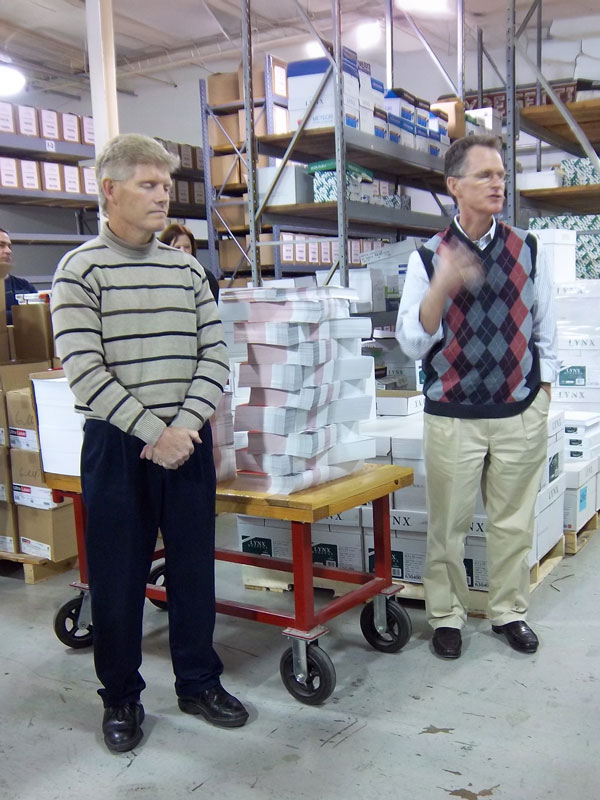
Michael and Joel O'BrienThe O’Briens consider hiring and training employees to be one of their most important tasks. It has also been the source of some of their most memorable moments, say the O’Briens who recall the prospective employee who came in and announced that, “there was no need for an interview because she was who they needed and they should just hire her.” Or the interviewee who walked into their office to say that he was going to work for them and he could start on April 23. Both are still with the company. And both are stellar employees.

Printing Partners today is what Susie and John started it out to be. . .and what Joel and Michael O’Brien have continued. A place to come for professional solutions from people who make you feel like you’re part of the family.

The Universe was created.


Creationists, please see Genesis 1.1

Evolutionists, this is when the Big Bang happened.

Please choose your point of view, we will not debate this topic here.

BiSheng creates movable wooden type in China.

Wooden movable type was first developed around 1040 AD by Bi Sheng (990–1051), as described by the Chinese scholar Shen Kuo (1031–1095), but was abandoned in favor of clay movable types due to uneveness of the movable wooden type after soaked in ink, also due to the presence of wood grains. Although the wooden type was more durable under the mechanical rigors of handling, repeated printing wore the character faces down, and the types could only be replaced by carving new pieces. This system was later enhanced by pressing wooden blocks into sand and casting metal types from the depression in copper, bronze, iron or tin. The set of wafer-like metal stamp types could be assembled to form pages, inked, and page impressions taken from rubbings on cloth or paper.

A particular difficulty posed the logistical problems of handling the several thousand characters whose command is required for full literacy in Chinese language. In spite of these shortcomings, wooden movable types were used continually in China. Even as late as 1733.

Movable metal type was created in Korea by Choe Yun-ui.


Transition from wood type to metal type occurred in 1234 during the Goryeo Dynasty of Korea and is credited to Choe Yun-ui. A set of ritual books, Sangjeong Gogeum Yemun were printed with the movable metal type in 1234. Examples of this metal type are on display in the Asian Reading Room of the Library of Congress in Washington, D.C. The oldest extant movable metal print book is the Jikji, printed in Korea in 1377.

Johannes Gutenberg brings movable metal type to Europe.


Johannes Gutenberg of Mainz is acknowledged as the first to invent a metal movable type printing system in Europe. Gutenberg was a goldsmith familiar with techniques of cutting punches for making coins from moulds. Between 1436 and 1450 he developed hardware and techniques for casting letters from matrices using a device called the hand mould. Gutenberg’s key invention and contribution to movable type printing in Europe, the hand mould was the first practical means of making cheap copies of letterpunches in the vast quantities needed to print complete books, making the movable type printing process a viable enterprise.

Indiana was established as the 19th state in the Union of the United States of America.


Present-day Indiana became part of the Northwest Territory in 1787. In 1800, Ohio was separated from the Northwest Territory by Congress, designating the rest of the land as the Indiana Territory. President Thomas Jefferson chose William Henry Harrison as the governor of the territory and Vincennes was established as the capital. After Michigan was separated and the Illinois Territory was formed, the size of Indiana was reduced to its current state.

[- Detailed History -]

John and Susie ColombeJohn and Susie Colombe opened an Insty-Prints franchise at 3824 S. Madison Ave, Indianapolis, IN.


In 1973 John and Susie Colombe determined a better solution for fast, affordable black and white printing. That year they opened an Insty-Prints franchise in a 900-square-foot space at 3824 Madison Avenue on the south side of Indianapolis. The quick-print industry was in its infancy and Colombes provided the personal attention that nurtured the company’s growth in its early years.

Insty-Prints expanded to include a downtown location at 134 N. Delaware St.


Within three years, Insty-Prints expanded to include a downtown location at 134 N. Delaware Street, which was later moved to 114 N. Delaware. In the early years, the business concentrated on 1- and 2-color printing; and expanding at a later date to include xerographic copying.

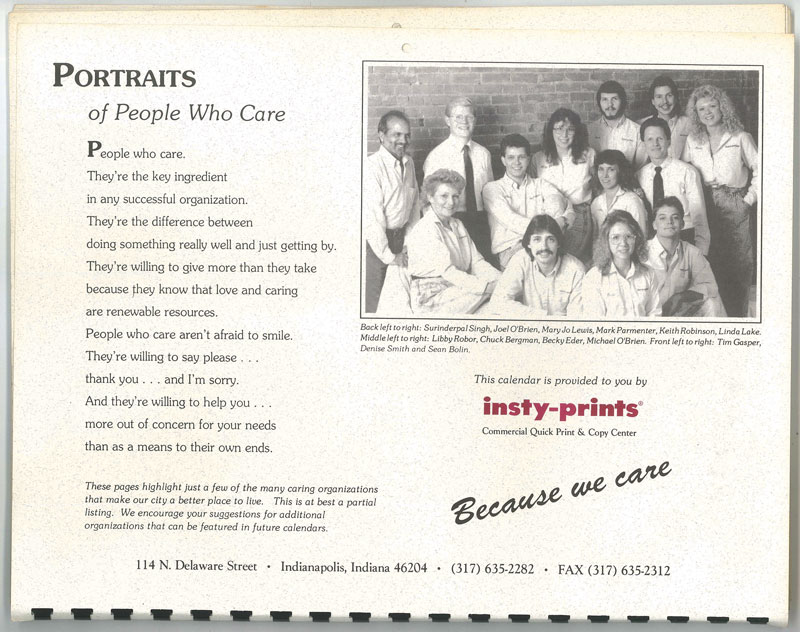
Within the next decade, Colombe’s business had grown to include four locations. By 1989, with 7 employees, their operation at 114 N. Delaware had annual revenues of more than $600,000. John credits his wife with their success as he recalls that Susie was “the strength of the business.”

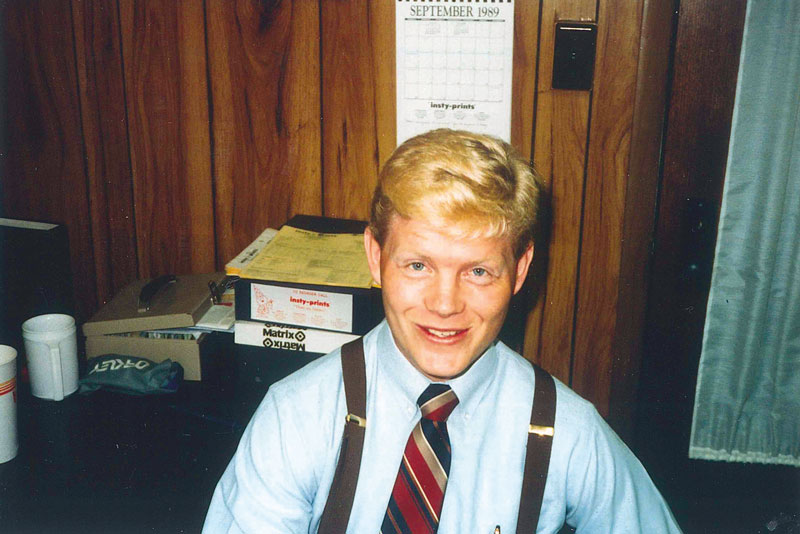
Michael O’Brien purchased the Delaware Street operation from the Colombes.

By 1989, the Colombe’s business had grown to include four locations and their operation at 114 N. Delaware had annual revenues of more than $600,000. John credits his wife for the success as he recalls Susie being, “the strength of the business.”

A quarter century after they had opened their first store, John and Susie Colombe took their first step toward retirement on June 1, 1989 when they sold the Delaware Street operation to Michael O’Brien.

Michael immediately realized he was in need of a partner and turned to his brother, Joel, who was working in Wisconsin at the time. As a favor, Michael had typeset Joel’s resume and recalls telling him, “If I had known you were so qualified, I would have offered you a job.” Joel spent two weeks of vacation working in the company and then returned to Wisconsin to resign his position as an agricultural loan officer.

The sale of Insty-Prints was negotiated over the course of the next two years and was kept confidential until the day before it occurred. John and Susie were both skeptical to turn their “family” over to new owners. They had always maintained that the employees were the company’s greatest asset, and this philosophy was put into action frequently. “Before it was general practice,” says John, “we tried to be flexible with our employees. We thought of them as part of our family.” This of course meant the bonus of receiving your age in dollars on every birthday.

As the “family” has matured, the O’Briens have continued that philosophy by implementing paid maternity and paternity leave as a way to retain employees.

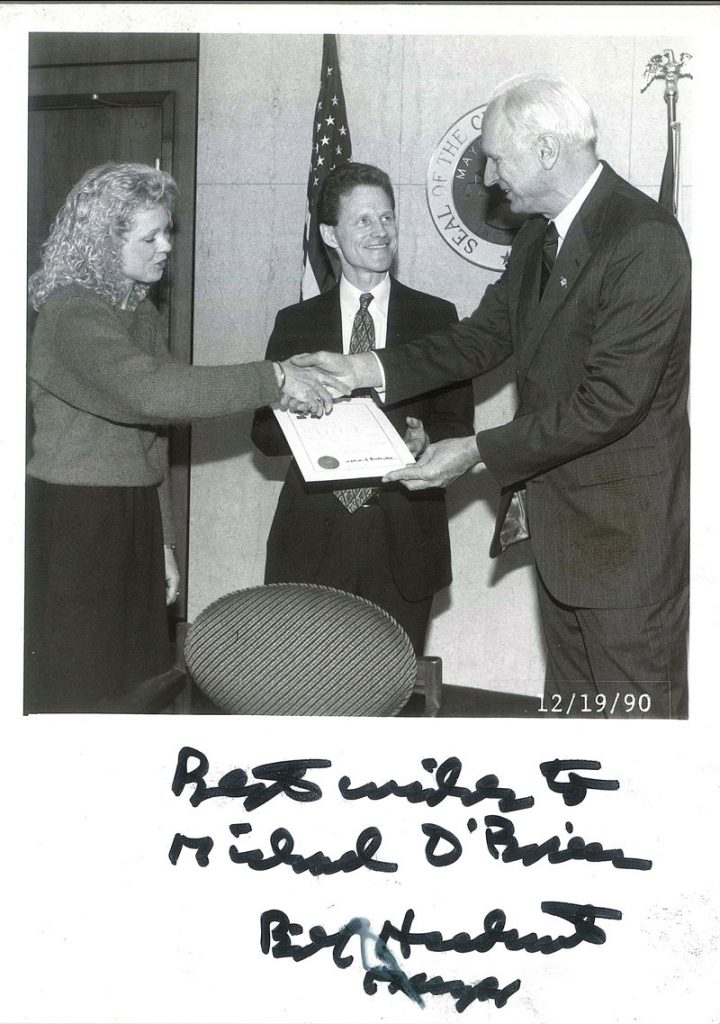
The Delaware location was named “Franchise of the Year” by Insty-Prints corporate office.

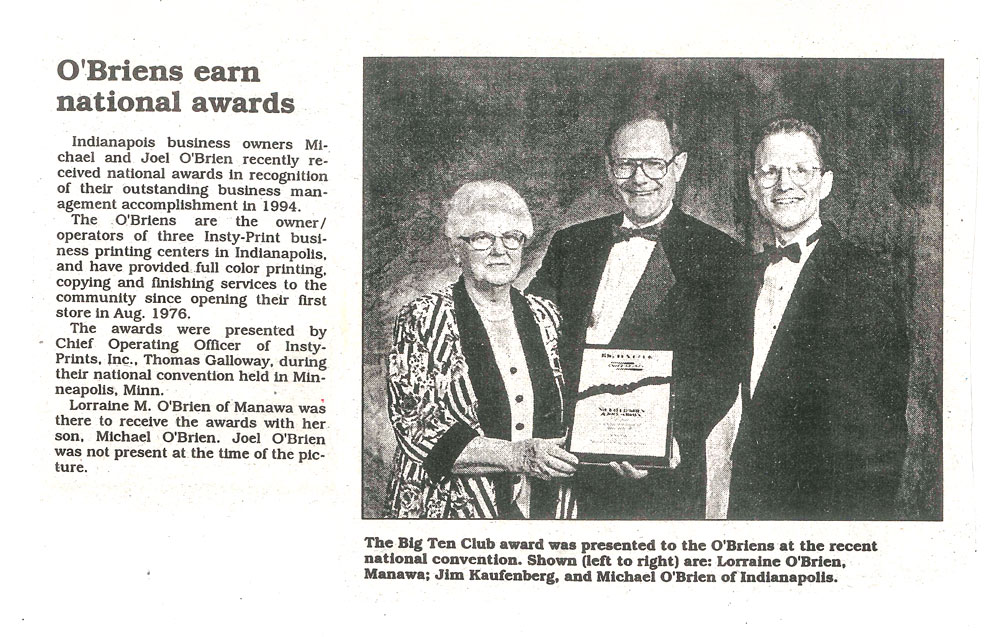
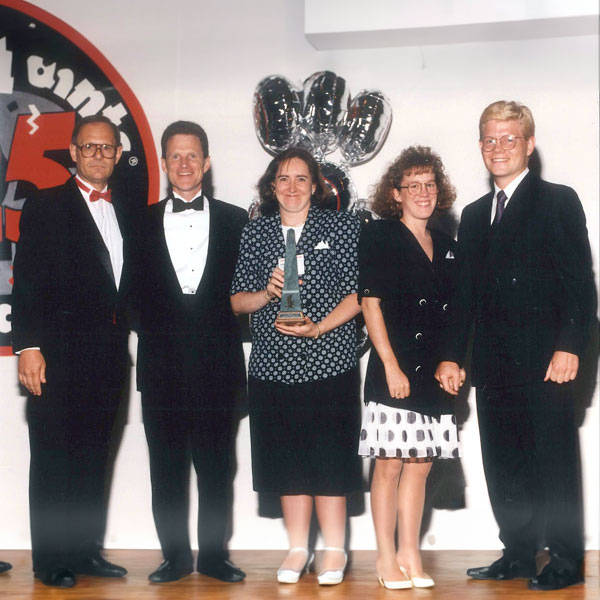
Franchise of the yearThe next decade brought continued growth as a result of a strong emphasis on sales and marketing. Joel and Michael pioneered the concept of personal selling, which was unusual in the quick-print market at that time. In 1991, annual sales exceeded $1 million and the following year the company was named “Franchise of the Year.”

The operation had expanded through acquisition to include three locations.

Franchise of the yearJohn and Susie continued their roles as mentors, not just to the O’Briens and their employees, but also to their peers. Through the years they earned numerous corporate awards, but the most rewarding was claimed in 1991, when Susie was honored by Insty-Prints, Inc. as “Woman Entrepreneur of the Year.” As a businesswoman, she set the standards for quality that continue at Printing Partners to this day. To accommodate its continued growth, in 1991, Insty-Prints leased adjacent space at 106 N. Delaware Street. By 1995, the operation had expanded through acquisition to include three locations, and it had become the largest multiple-unit Insty-Prints in the world with annual sales of more than $3 million.

From the beginning stages, Joel and Michael divided the responsibilies to cater to each other’s strengths, with Joel focusing on finance, administration and operations while Michael concentrated on sales and marketing aspects of the company. In many ways, their roles mirror those adopted by John and Susie. While Susie and Joel tended to be analytical and disciplined, Michael and John tended to be more creative and more likely than their partners to shoot from the hip. In both cases, the chemistry worked.

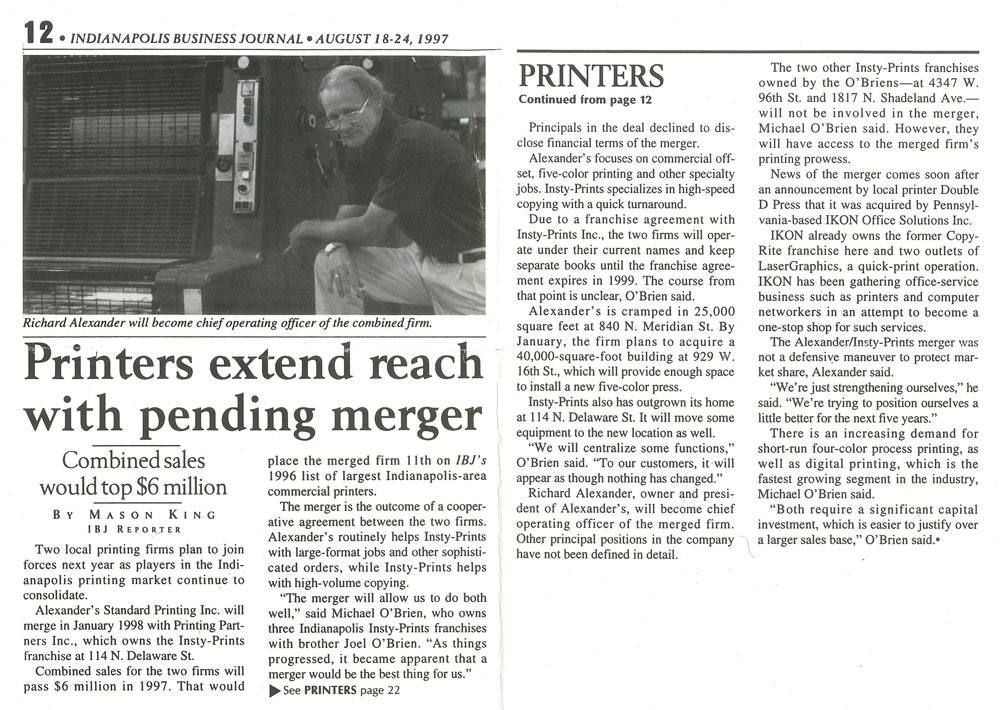
Having outgrown its Delaware Street location, the company purchased a building at 929 W. 16th Street and moved into space it shared with Alexander’s Standard Printing.

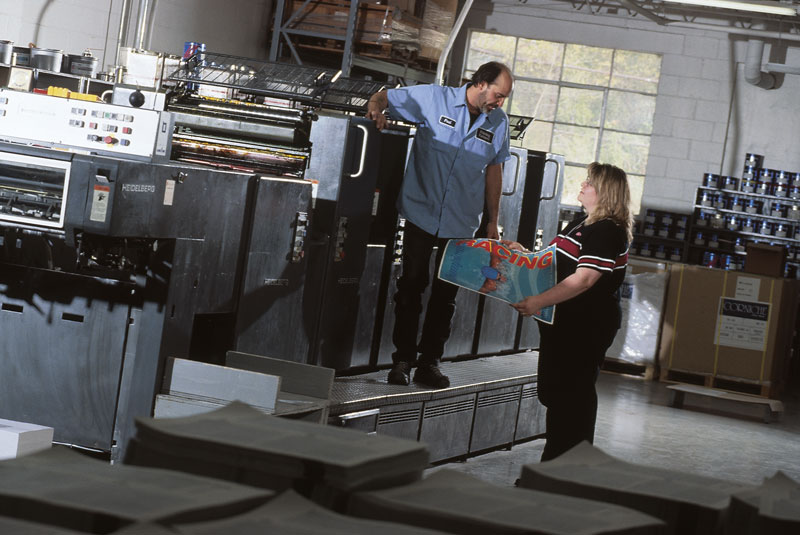
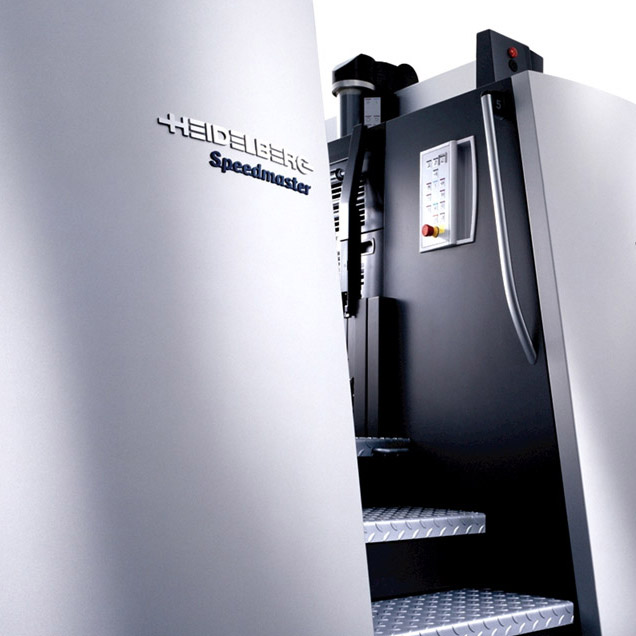
By 1998, having outgrown its Delaware Street location, the company purchased a building at 929 W. 16th Street and moved into a space it shared with Alexander’s Standard Printing. The move culminated a strategic alliance between the two companies that continued for almost a decade. Dick and Susie Alexander possessed an understanding of the trade that complemented the O’Briens’ marketing and sales perspective. Dating back to 1924, Standard Printing evolved from a letterpress shop into a commercial sheet-fed printer with both 2- and 5-color Heidelberg presses. As mentors, both Alexanders generously shared their knowledge with their new partners.

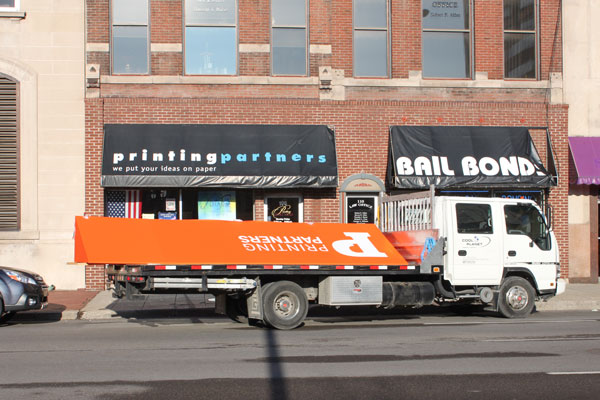
Insty-Prints franchise was terminated and the company began doing business as Printing Partners.

Shortly after their move, the Insty-Prints franchise was terminated and the company began doing business as Printing Partners. The franchise, and the name associated with it, had become a detriment to a company that was evolving into a commercial printer. That was evidenced in 2000 when a second 5-color Heidelberg was purchased, doubling the company’s 4-color process capacity.

Printing Partners purchased Alexander’s Standard Printing.

In August 2000 the alliance between the two partners was formalized when Printing Partners purchased Alexander’s Standard Printing. The purchase brought together two complementary, but diverse cultures. Blending the two created a stronger, more disciplined team. Many of the Standard employees, including Tim O’Brien and Lenard Brown, had been with the company since the early 1970s. All of them were craftsman and as such they set the quality standard for the new organization.

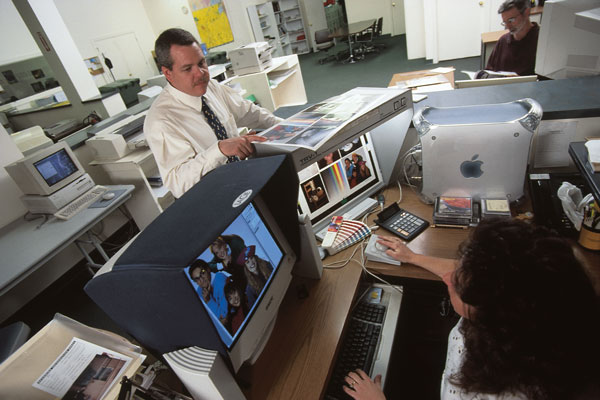
Throughout the 90s, the pace of technological change quickened. By the beginning of the new millennium, the speed and quality of digital printing had dramatically improved. Offset printing saw the introduction of computer-to-plate technology which eliminated the use of film and the need for conventional stripping. The end result was enhanced quality and faster turn time.
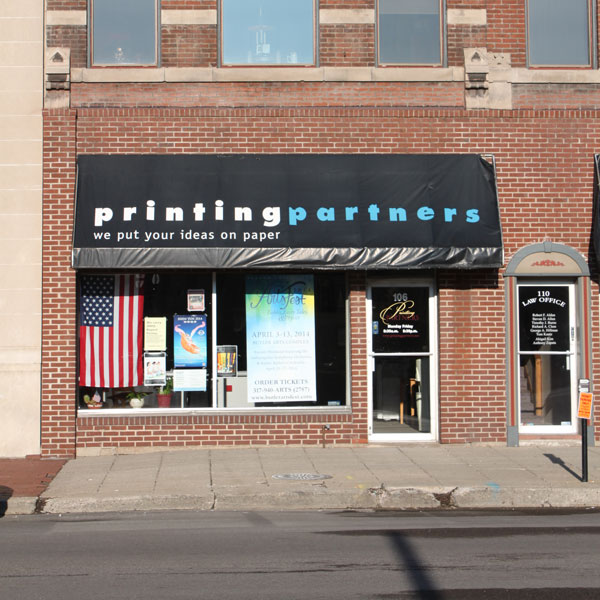
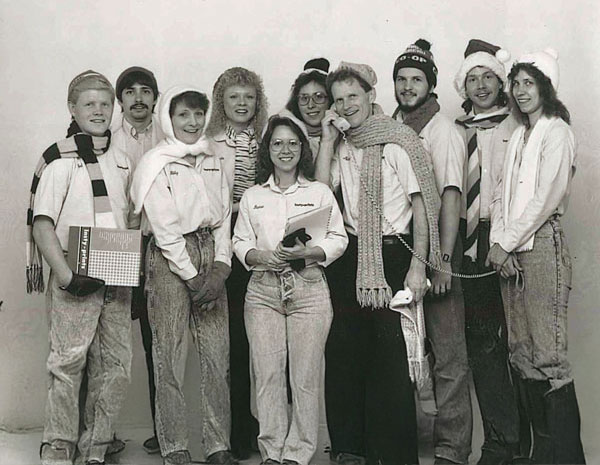

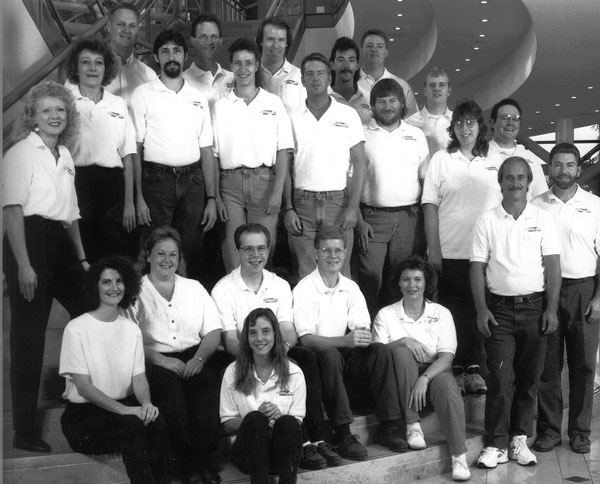
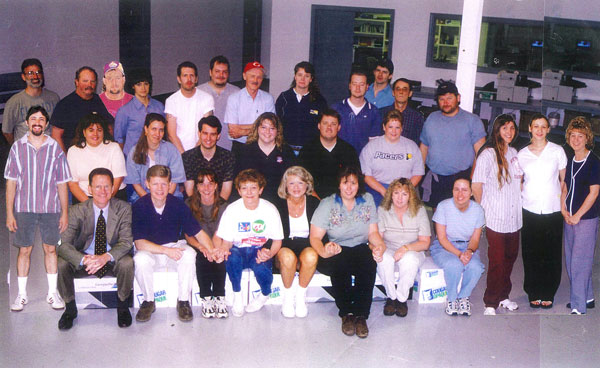
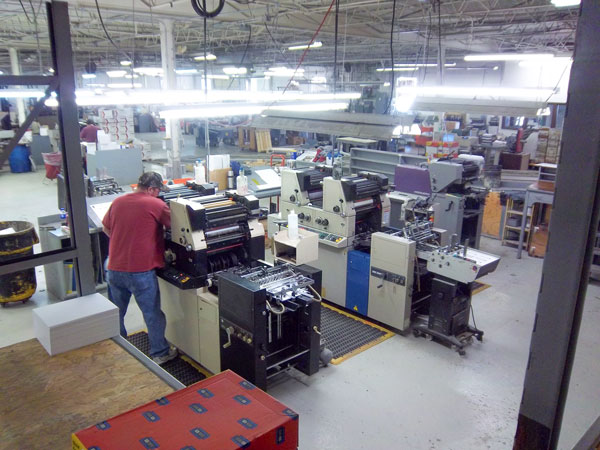
Printing Partners has grown to become one of Indianapolis’ top ten printers with more than 80 employees generating annual revenues of $10 million at two locations.

Today, Printing Partners has grown to become one of Indianapolis’ top ten printers with more than 80 employees generating annual revenues of $10 million at two locations. Its mission, however, remains the same: To provide clients personal attention and professional communications solutions.


In December 1813, Corydon was established as the capital of the Indiana Territory. Two years later, a petition for statehood was approved by the Indiana legislature and sent to Congress. Afterwards, an Enabling Act was passed to provide an election of delegates to write a constitution for Indiana. On June 10, 1816, delegates assembled at Corydon to write the constitution, which was completed in nineteen days. President James Madison approved Indiana's admission into the union as the nineteenth state on December 11, 1816. In 1825, the state capital was moved from Corydon to Indianapolis and 26 years later, a new constitution was adopted.

Indiana is located in the Great Lakes region, and with approximately 6.3 million residents, is ranked 16th in population and 17th in population density. Indiana is ranked 38th in land area, and is the smallest state in the continental US west of the Appalachian Mountains. Its capital and largest city is Indianapolis, having the largest city proper population of any state capital east of the Mississippi River.

Residents of Indiana are known as Hoosiers, though the etymology of the term is unknown. The state’s name means “Land of the Indians”, or simply “Indian Land”. This name dates back to at least the 1768 and was first used by Congress when the Indiana Territory was incorporated in 1800, before which it had been part of the Northwest Territory. Prior to this, Indiana had been primarily inhabited by Native Americans.
(This information was gathered from Wikipedia 2010)


Printing Partners on LinkedIN Printing Partners on Facebook